hannah earns $52,000 per year, receives 10 days pto, 6% retirement matching, and receives 60% employer…
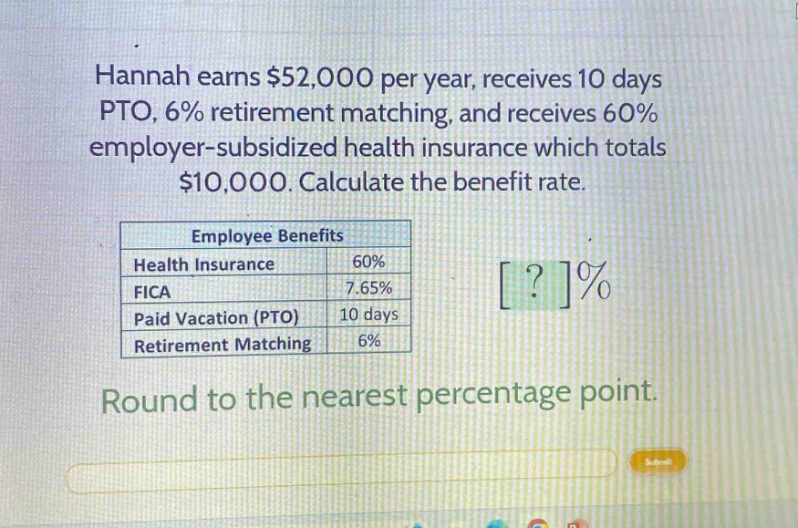
hannah earns $52,000 per year, receives 10 days pto, 6% retirement matching, and receives 60% employer - subsidized health insurance which totals $10,000. calculate the benefit rate.\n\n|employee benefits| |\n|--|--|\n|health insurance|60%|\n|fica|7.65%|\n|paid vacation (pto)|10 days|\n|retirement matching|6%|\n\nround to the nearest percentage point.
Answer
Explanation:
Step1: Calculate value of PTO
Assume a 20 - work - day month and 12 months in a year, so 20×12 = 240 workdays in a year. PTO is 10 days. The value of PTO as a percentage of workdays is $\frac{10}{240}\approx0.0417$ or 4.17%.
Step2: Calculate total benefits percentage
The health - insurance subsidy is 60% of $10,000. But we want to find the total benefit rate relative to the salary. The retirement matching is 6%, PTO is about 4.17%, and assume FICA is not part of employer - provided benefits (it's a mandatory deduction). The total benefit rate is the sum of the PTO percentage and the retirement - matching percentage and the health - insurance subsidy percentage. The health - insurance subsidy amount is $10000\times0.6 = 6000$. The total benefits amount is the sum of the value from PTO (in terms of salary equivalent), retirement matching amount and health - insurance subsidy amount. The retirement matching amount is $52000\times0.06=3120$. The value of PTO (assuming salary is evenly distributed over workdays) is $\frac{52000}{240}\times10\approx2166.67$. The total benefits amount is $6000 + 3120+2166.67 = 11286.67$. The benefit rate is $\frac{11286.67}{52000}\times100%\approx21.7%$. Rounding to the nearest percentage point, we get 22%.
Answer:
22%