ivy is trying to manage the money she spends on lunch. between eating out and buying groceries for bagged…
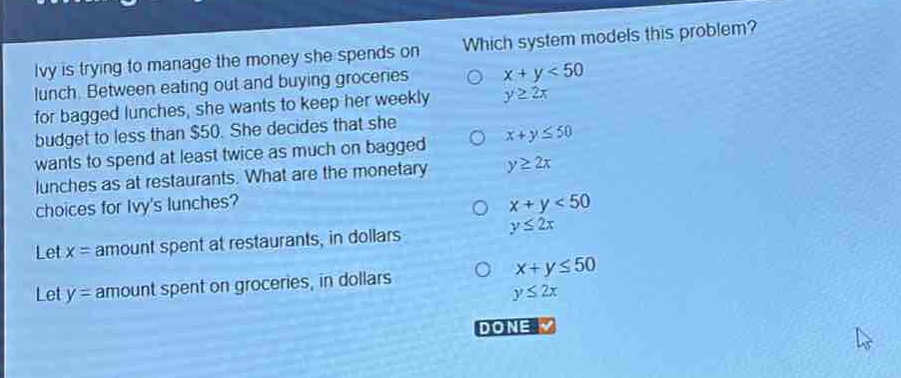
ivy is trying to manage the money she spends on lunch. between eating out and buying groceries for bagged lunches, she wants to keep her weekly budget to less than $50. she decides that she wants to spend at least twice as much on bagged lunches as at restaurants. what are the monetary choices for ivys lunches? let x = amount spent at restaurants, in dollars let y = amount spent on groceries, in dollars which system models this problem? x + y < 50 y≥2x x + y≤50 y≥2x x + y < 50 y≤2x x + y≤50 y≤2x done
Answer
Explanation:
Step1: Analyze budget constraint
Ivy wants her weekly budget to be less than $50. So the sum of money spent at restaurants ($x$) and on groceries ($y$) should satisfy $x + y<50$.
Step2: Analyze spending - ratio constraint
She wants to spend at least twice as much on bagged lunches (groceries $y$) as at restaurants ($x$), which means $y\geq2x$.
Answer:
$x + y<50$, $y\geq2x$