jason works in human resources for a large company, and part of his job is to minimize the number of…
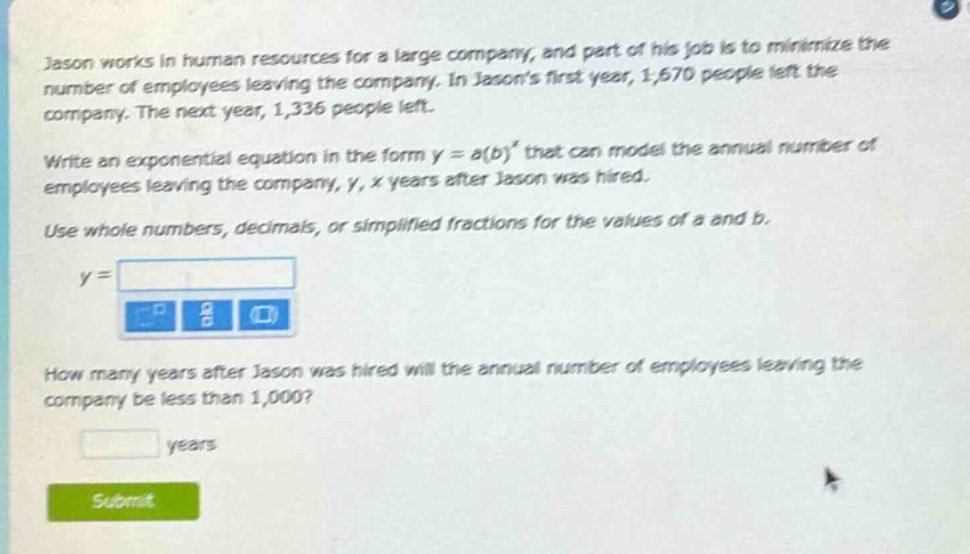
jason works in human resources for a large company, and part of his job is to minimize the number of employees leaving the company. in jasons first year, 1,670 people left the company. the next year, 1,336 people left. write an exponential equation in the form y = a(b)^x that can model the annual number of employees leaving the company, y, x years after jason was hired. use whole numbers, decimals, or simplified fractions for the values of a and b. y = how many years after jason was hired will the annual number of employees leaving the company be less than 1,000? years
Answer
Explanation:
Step1: Find the value of a
When (x = 0) (the year Jason was hired), assume the number of employees leaving is the number in the first - year data given. So (a=1670) since when (x = 0), (y=a(b)^{0}=a).
Step2: Find the value of b
We know that when (x = 1), (y = 1336) and (a = 1670). Substitute into the equation (y=a(b)^{x}), we get (1336=1670(b)^{1}). Then (b=\frac{1336}{1670}=\frac{4}{5}=0.8). The exponential equation is (y = 1670(0.8)^{x}).
Step3: Solve for x when (y\lt1000)
Set up the inequality (1670(0.8)^{x}\lt1000). First, divide both sides by 1670: ((0.8)^{x}\lt\frac{1000}{1670}=\frac{100}{167}\approx0.5988). Take the natural - logarithm of both sides: (\ln(0.8)^{x}\lt\ln(0.5988)). Using the property of logarithms (\ln a^{b}=b\ln a), we have (x\ln(0.8)\lt\ln(0.5988)). Since (\ln(0.8)\lt0), when we divide both sides of the inequality by (\ln(0.8)), the direction of the inequality sign changes. So (x>\frac{\ln(0.5988)}{\ln(0.8)}). (\ln(0.5988)\approx - 0.513) and (\ln(0.8)\approx - 0.223). Then (x>\frac{-0.513}{-0.223}\approx2.3). Since (x) represents the number of years and it must be a whole number, (x = 3).
Answer:
The exponential equation is (y = 1670(0.8)^{x}), and the number of years is 3.