john owns a clothing store that sells graphic t - shirts and shorts. he sells the t - shirts for $5 each and…
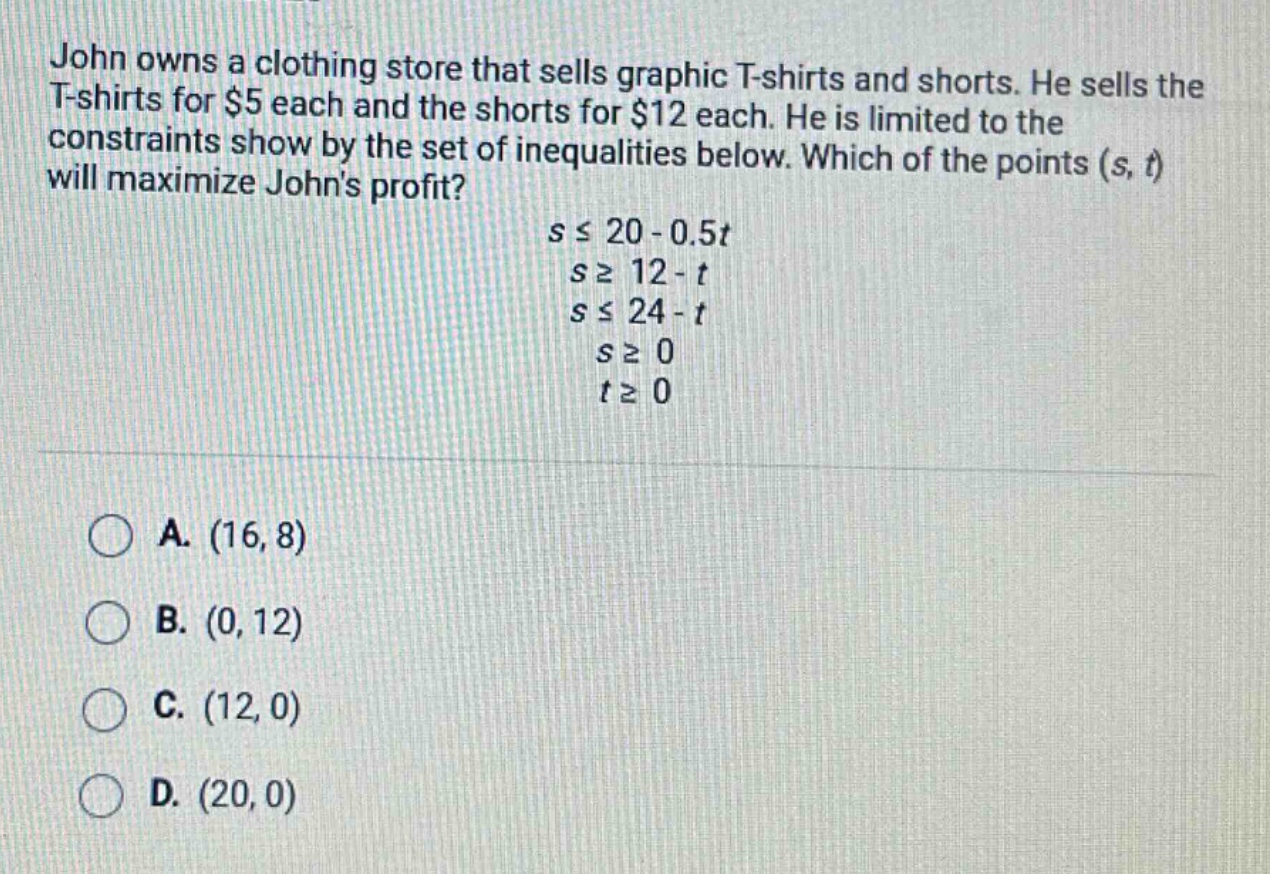
john owns a clothing store that sells graphic t - shirts and shorts. he sells the t - shirts for $5 each and the shorts for $12 each. he is limited to the constraints show by the set of inequalities below. which of the points (s, t) will maximize johns profit?\n\n$sleq20 - 0.5t$\n$sgeq12 - t$\n$sleq24 - t$\n$sgeq0$\n$tgeq0$\n\na. (16, 8)\nb. (0, 12)\nc. (12, 0)\nd. (20, 0)
Answer
Answer:
A. (16, 8)
Explanation:
Step1: Define the profit function
The profit function $P = 12s+5t$ since shorts ($s$) sell for $12$ dollars each and T - shirts ($t$) sell for $5$ dollars each.
Step2: Check option A
For point $(16,8)$:
- Check inequalities:
- $s = 16$, $t = 8$.
- $s\leq20 - 0.5t$ gives $16\leq20-0.5\times8=20 - 4 = 16$ (True).
- $s\geq12 - t$ gives $16\geq12 - 8=4$ (True).
- $s\leq24 - t$ gives $16\leq24 - 8 = 16$ (True).
- $s\geq0$ (True) and $t\geq0$ (True).
- Calculate profit: $P=12\times16 + 5\times8=192+40=232$.
Step3: Check option B
For point $(0,12)$:
- Check inequalities: All inequalities are satisfied.
- Calculate profit: $P=12\times0+5\times12 = 60$.
Step4: Check option C
For point $(12,0)$:
- Check inequalities: All inequalities are satisfied.
- Calculate profit: $P=12\times12+5\times0=144$.
Step5: Check option D
For point $(20,0)$:
- Check inequalities: All inequalities are satisfied.
- Calculate profit: $P=12\times20+5\times0 = 240$. Since $232>60$, $232>144$ and $240>232$ is false, the point $(16,8)$ maximizes the profit.