jurvin enterprises is a manufacturing company with no beginning inventories. a subset of the transactions it…
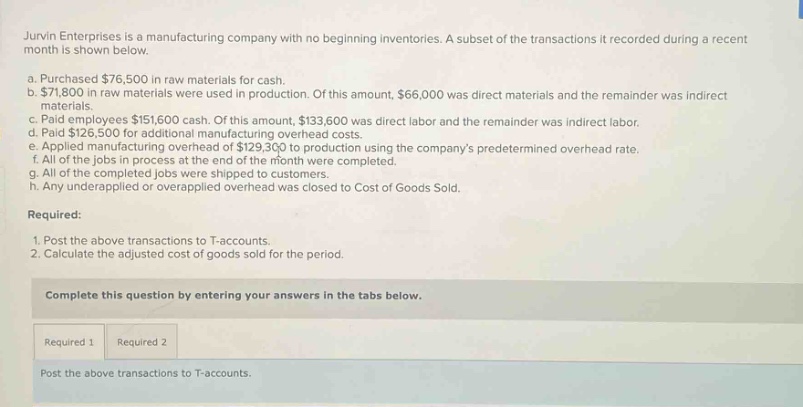
jurvin enterprises is a manufacturing company with no beginning inventories. a subset of the transactions it recorded during a recent month is shown below.\na. purchased $76,500 in raw materials for cash.\nb. $71,800 in raw materials were used in production. of this amount, $66,000 was direct materials and the remainder was indirect materials.\nc. paid employees $151,600 cash. of this amount, $133,600 was direct labor and the remainder was indirect labor.\nd. paid $126,500 for additional manufacturing overhead costs.\ne. applied manufacturing overhead of $129,300 to production using the companys predetermined overhead rate.\nf. all of the jobs in process at the end of the month were completed.\ng. all of the completed jobs were shipped to customers.\nh. any underapplied or overapplied overhead was closed to cost of goods sold.\nrequired:\n1. post the above transactions to t - accounts.\n2. calculate the adjusted cost of goods sold for the period.\ncomplete this question by entering your answers in the tabs below.\nrequired 1 required 2\npost the above transactions to t - accounts.
Answer
Explanation:
Step1: Analyze raw - materials transactions
Raw materials purchased: Debit Raw Materials Inventory $76,500$, Credit Cash $76,500$. Raw materials used: Debit Work - in - Process Inventory (direct materials) $66,000$, Debit Manufacturing Overhead (indirect materials: $71,800 - 66,000=5,800$), Credit Raw Materials Inventory $71,800$.
Step2: Analyze labor transactions
Labor paid: Debit Work - in - Process Inventory (direct labor) $133,600$, Debit Manufacturing Overhead (indirect labor: $151,600 - 133,600 = 18,000$), Credit Cash $151,600$.
Step3: Analyze additional overhead transaction
Debit Manufacturing Overhead $126,500$, Credit Cash $126,500$.
Step4: Analyze applied overhead transaction
Debit Work - in - Process Inventory $129,300$, Credit Manufacturing Overhead $129,300$.
Step5: Analyze job completion transaction
Debit Finished Goods Inventory, Credit Work - in - Process Inventory (sum of direct materials, direct labor and applied overhead in Work - in - Process).
Step6: Analyze job shipment transaction
Debit Cost of Goods Sold, Credit Finished Goods Inventory.
Step7: Calculate actual overhead
Actual overhead=$5,800 + 18,000+126,500=150,300$.
Step8: Calculate over/under - applied overhead
Over/under - applied overhead = Applied overhead - Actual overhead=$129,300 - 150,300=- 21,000$ (under - applied).
Step9: Adjust cost of goods sold
Adjusted cost of goods sold = Unadjusted cost of goods sold+Under - applied overhead. Since all jobs are completed and shipped, unadjusted cost of goods sold is the sum of direct materials, direct labor and applied overhead in Work - in - Process. Unadjusted cost of goods sold=$66,000 + 133,600+129,300 = 328,900$. Adjusted cost of goods sold=$328,900+21,000 = 349,900$.
Answer:
- For T - accounts:
- Raw Materials Inventory: Debit $76,500$, Credit $71,800$.
- Work - in - Process Inventory: Debit $66,000$ (direct materials), $133,600$ (direct labor), $129,300$ (applied overhead).
- Manufacturing Overhead: Debit $5,800$ (indirect materials), $18,000$ (indirect labor), $126,500$ (additional overhead), Credit $129,300$ (applied overhead).
- Cash: Credit $76,500$ (raw materials purchase), $151,600$ (labor payment), $126,500$ (additional overhead payment).
- Finished Goods Inventory: Debit (sum of Work - in - Process at completion), Credit (to Cost of Goods Sold).
- Cost of Goods Sold: Debit (sum of Finished Goods at shipment)+$21,000$ (under - applied overhead).
- Adjusted cost of goods sold: $349,900$