the ledger of concord corporation at the end of the current year shows accounts receivable $75,800; credit…
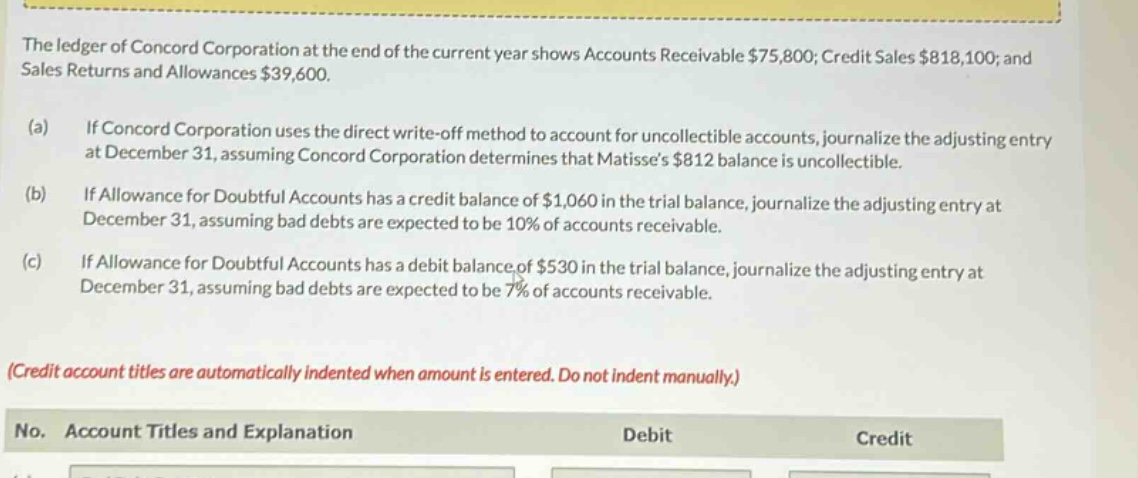
the ledger of concord corporation at the end of the current year shows accounts receivable $75,800; credit sales $818,100; and sales returns and allowances $39,600. (a) if concord corporation uses the direct write - off method to account for uncollectible accounts, journalize the adjusting entry at december 31, assuming concord corporation determines that matisses $812 balance is uncollectible. (b) if allowance for doubtful accounts has a credit balance of $1,060 in the trial balance, journalize the adjusting entry at december 31, assuming bad debts are expected to be 10% of accounts receivable. (c) if allowance for doubtful accounts has a debit balance of $530 in the trial balance, journalize the adjusting entry at december 31, assuming bad debts are expected to be 7% of accounts receivable. (credit account titles are automatically indented when amount is entered. do not indent manually.) no. account titles and explanation debit credit
Answer
Explanation:
Step1: Determine bad - debt expense for direct write - off method
Under the direct write - off method, when an account is determined to be uncollectible, we directly write off the account. The bad - debt expense is equal to the uncollectible amount. Bad Debt Expense = $812
Step2: Journalize entry for direct write - off method
The journal entry is to debit Bad Debt Expense and credit Accounts Receivable - Matisse.
| Account Titles and Explanation | Debit | Credit |
|---|---|---|
| Bad Debt Expense | $812 | |
| Accounts Receivable - Matisse | $812 |
Step3: Calculate required allowance for part (b)
Accounts Receivable = $75,800. Required allowance = 10% of Accounts Receivable = 0.10×$75,800 = $7,580 Existing credit balance in Allowance for Doubtful Accounts = $1,060 Bad Debt Expense = Required allowance - Existing credit balance = $7,580 - $1,060 = $6,520
Step4: Journalize entry for part (b)
| Account Titles and Explanation | Debit | Credit |
|---|---|---|
| Bad Debt Expense | $6,520 | |
| Allowance for Doubtful Accounts | $6,520 |
Step5: Calculate required allowance for part (c)
Accounts Receivable = $75,800. Required allowance = 7% of Accounts Receivable = 0.07×$75,800 = $5,306 Existing debit balance in Allowance for Doubtful Accounts = $530 Bad Debt Expense = Required allowance+Existing debit balance = $5,306 + $530 = $5,836
Step6: Journalize entry for part (c)
| Account Titles and Explanation | Debit | Credit |
|---|---|---|
| Bad Debt Expense | $5,836 | |
| Allowance for Doubtful Accounts | $5,836 |
Answer:
(a)
| Account Titles and Explanation | Debit | Credit |
|---|---|---|
| Bad Debt Expense | $812 | |
| Accounts Receivable - Matisse | $812 | |
| (b) | ||
| Account Titles and Explanation | Debit | Credit |
| ---- | ---- | ---- |
| Bad Debt Expense | $6,520 | |
| Allowance for Doubtful Accounts | $6,520 | |
| (c) | ||
| Account Titles and Explanation | Debit | Credit |
| ---- | ---- | ---- |
| Bad Debt Expense | $5,836 | |
| Allowance for Doubtful Accounts | $5,836 |