a manager asks his workers how much pasta salad to order for the company picnic. two workers volunteer to…
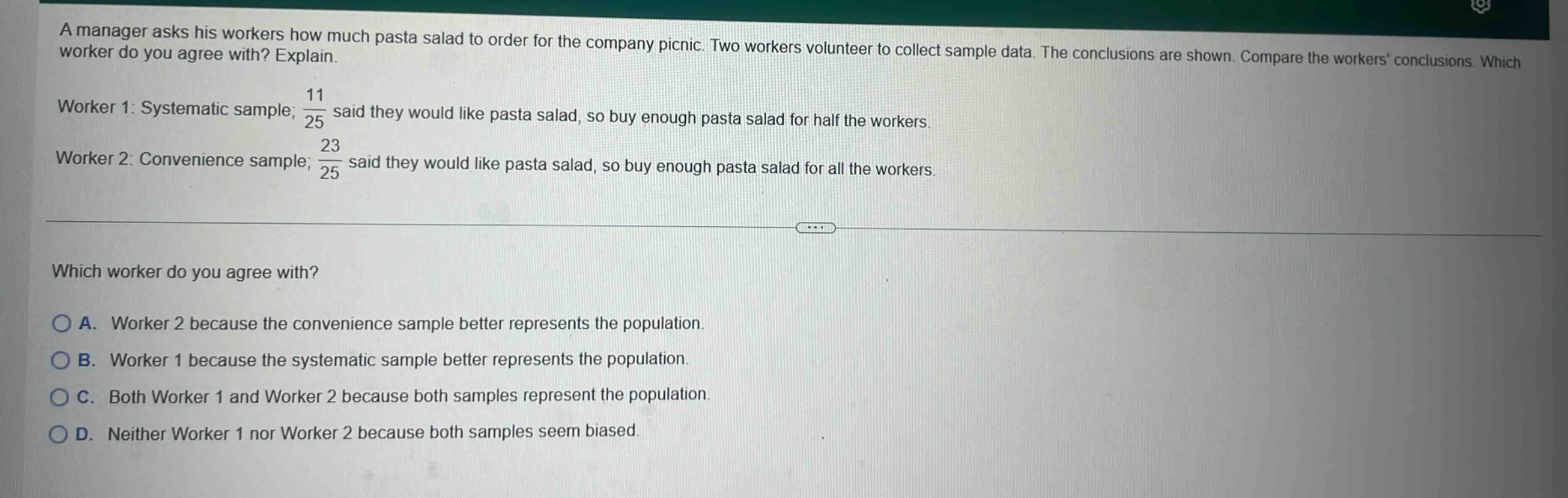
a manager asks his workers how much pasta salad to order for the company picnic. two workers volunteer to collect sample data. the conclusions are shown. compare the workers conclusions. which worker do you agree with? explain.\nworker 1: systematic sample; $\frac{11}{25}$ said they would like pasta salad, so buy enough pasta salad for half the workers.\nworker 2: convenience sample; $\frac{23}{25}$ said they would like pasta salad, so buy enough pasta salad for all the workers.\nwhich worker do you agree with?\na. worker 2 because the convenience sample better represents the population.\nb. worker 1 because the systematic sample better represents the population.\nc. both worker 1 and worker 2 because both samples represent the population.\nd. neither worker 1 nor worker 2 because both samples seem biased.
Answer
Brief Explanations:
Systematic sampling has a more regular selection method and is generally less biased than convenience sampling which is based on ease of access. However, both samples here may be biased. The systematic - sample result of $\frac{11}{25}$ and convenience - sample result of $\frac{23}{25}$ have a large difference, indicating potential issues with representativeness.
Answer:
D. Neither Worker 1 nor Worker 2 because both samples seem biased.