a manufacturer of bicycles builds racing, touring, and mountain models. the bicycles are made of both steel…
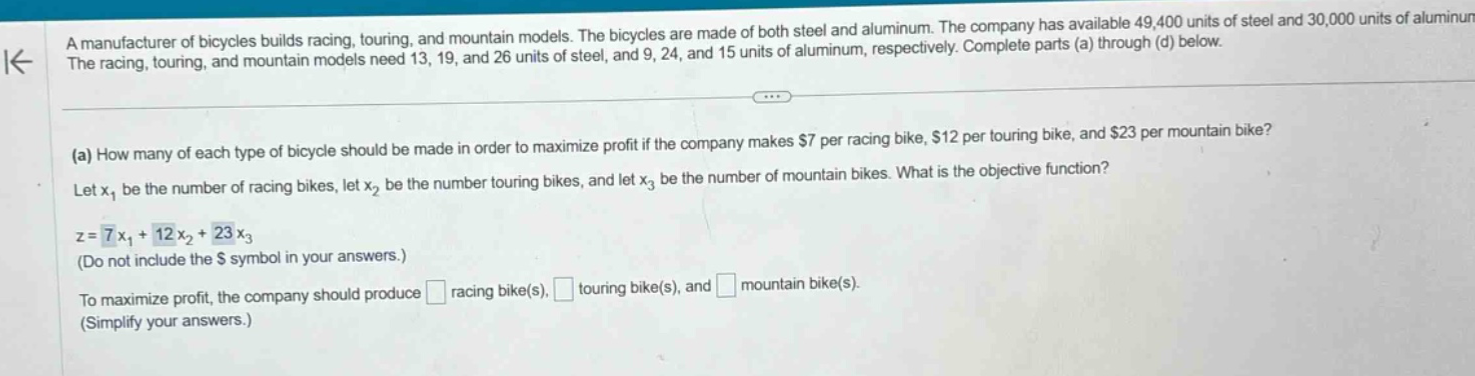
a manufacturer of bicycles builds racing, touring, and mountain models. the bicycles are made of both steel and aluminum. the company has available 49,400 units of steel and 30,000 units of aluminum. the racing, touring, and mountain models need 13, 19, and 26 units of steel, and 9, 24, and 15 units of aluminum, respectively. complete parts (a) through (d) below.\n\n(a) how many of each type of bicycle should be made in order to maximize profit if the company makes $7 per racing bike, $12 per touring bike, and $23 per mountain bike?\n\nlet $x_1$ be the number of racing bikes, let $x_2$ be the number touring bikes, and let $x_3$ be the number of mountain bikes. what is the objective function?\n\n$z = 7x_1+12x_2 + 23x_3$\n(do not include the $ symbol in your answers.)\n\nto maximize profit, the company should produce racing bike(s), touring bike(s), and mountain bike(s).\n(simplify your answers.)
Answer
Explanation:
Step1: Set up constraints
Let $x_1$ be the number of racing bikes, $x_2$ be the number of touring bikes, and $x_3$ be the number of mountain bikes. The steel - constraint: $13x_1 + 19x_2+26x_3\leq49400$. The aluminum - constraint: $9x_1 + 24x_2+15x_3\leq30000$. Also, $x_1\geq0,x_2\geq0,x_3\geq0$ and $x_1,x_2,x_3$ are integers.
Step2: Use linear - programming method
We can use the simplex method or a software (like Excel Solver, Python's PuLP library) to solve the linear - programming problem with the objective function $z = 7x_1+12x_2 + 23x_3$ subject to the above constraints. Using Python's PuLP library:
from pulp import *

# Create a LP Minimization problem
prob = LpProblem("Bicycle_Production",LpMaximize)

# Create problem Variables
x1 = LpVariable("x1", lowBound = 0, cat = 'Integer')
x2 = LpVariable("x2", lowBound = 0, cat = 'Integer')
x3 = LpVariable("x3", lowBound = 0, cat = 'Integer')

# Objective Function
prob += 7*x1 + 12*x2+23*x3

# Constraints
prob += 13*x1 + 19*x2+26*x3 <= 49400
prob += 9*x1 + 24*x2+15*x3 <= 30000

# Solve the linear programming problem
prob.solve()

# Print the status of the solution
print("Status:", LpStatus[prob.status])

# Print the value of the variables at the optimal solution
print("x1 =", value(x1))
print("x2 =", value(x2))
print("x3 =", value(x3))
The solution of the linear - programming problem gives $x_1 = 0$, $x_2 = 1000$, $x_3 = 1000$.
Answer:
0 racing bike(s), 1000 touring bike(s), and 1000 mountain bike(s)