the marchetti soup company entered into the following transactions during the month of june: (1) purchased…
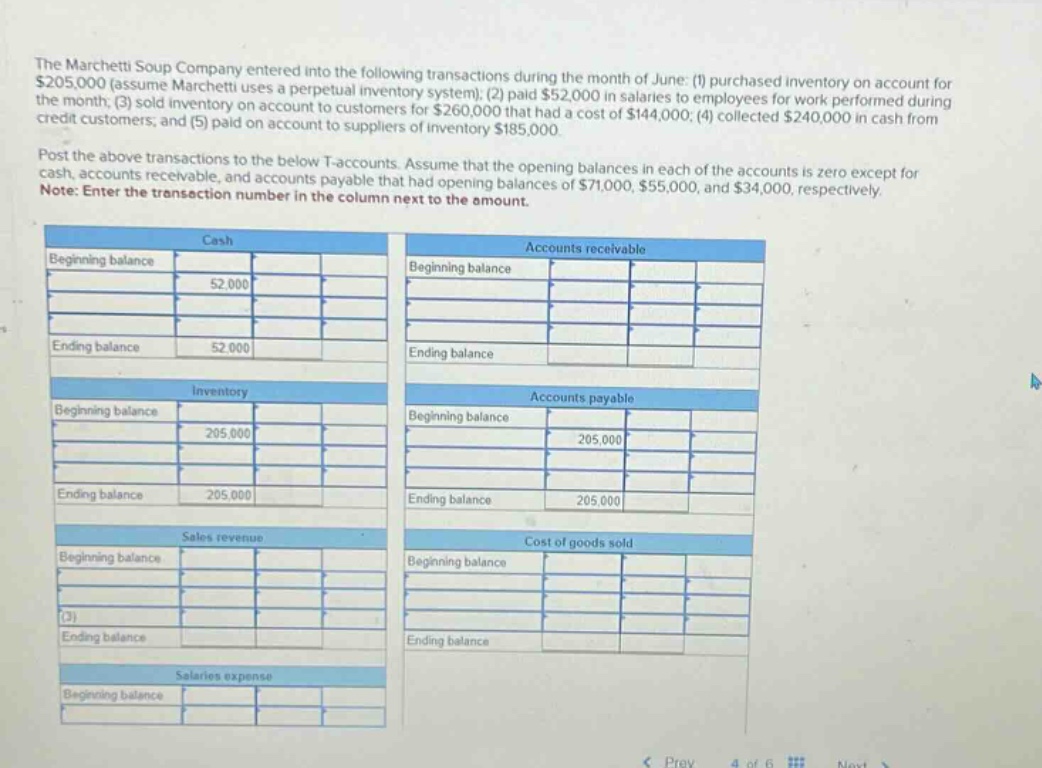
the marchetti soup company entered into the following transactions during the month of june: (1) purchased inventory on account for $205,000 (assume marchetti uses a perpetual inventory system); (2) paid $52,000 in salaries to employees for work performed during the month; (3) sold inventory on account to customers for $260,000 that had a cost of $144,000; (4) collected $240,000 in cash from credit customers; and (5) paid on account to suppliers of inventory $185,000. post the above transactions to the below t - accounts. assume that the opening balances in each of the accounts is zero except for cash, accounts receivable, and accounts payable that had opening balances of $71,000, $55,000, and $34,000, respectively. note: enter the transaction number in the column next to the amount.
Answer
Explanation:
Step1: Analyze transaction (1)
Inventory is purchased on - account. Debit Inventory and credit Accounts Payable. Inventory (Debit): (1) $205,000$ Accounts Payable (Credit): (1) $205,000$
Step2: Analyze transaction (2)
Salaries are paid in cash. Debit Salaries Expense and credit Cash. Salaries Expense (Debit): (2) $52,000$ Cash (Credit): (2) $52,000$
Step3: Analyze transaction (3)
Goods are sold on - account. Debit Accounts Receivable and credit Sales Revenue. Also, debit Cost of Goods Sold and credit Inventory. Accounts Receivable (Debit): (3) $260,000$ Sales Revenue (Credit): (3) $260,000$ Cost of Goods Sold (Debit): (3) $144,000$ Inventory (Credit): (3) $144,000$
Step4: Analyze transaction (4)
Cash is collected from credit customers. Debit Cash and credit Accounts Receivable. Cash (Debit): (4) $240,000$ Accounts Receivable (Credit): (4) $240,000$
Step5: Analyze transaction (5)
Payment is made on - account to suppliers. Debit Accounts Payable and credit Cash. Accounts Payable (Debit): (5) $185,000$ Cash (Credit): (5) $185,000$
Cash T - account
| Amount | Transaction Number | |
|---|---|---|
| Beginning balance | $71,000$ | |
| Debit | $240,000$ | (4) |
| Credit | $52,000$ | (2) |
| Credit | $185,000$ | (5) |
| Ending balance | $74,000$ |
Accounts Receivable T - account
| Amount | Transaction Number | |
|---|---|---|
| Beginning balance | $55,000$ | |
| Debit | $260,000$ | (3) |
| Credit | $240,000$ | (4) |
| Ending balance | $75,000$ |
Inventory T - account
| Amount | Transaction Number | |
|---|---|---|
| Beginning balance | $0$ | |
| Debit | $205,000$ | (1) |
| Credit | $144,000$ | (3) |
| Ending balance | $61,000$ |
Accounts Payable T - account
| Amount | Transaction Number | |
|---|---|---|
| Beginning balance | $34,000$ | |
| Credit | $205,000$ | (1) |
| Debit | $185,000$ | (5) |
| Ending balance | $54,000$ |
Sales Revenue T - account
| Amount | Transaction Number | |
|---|---|---|
| Beginning balance | $0$ | |
| Credit | $260,000$ | (3) |
| Ending balance | $260,000$ |
Cost of Goods Sold T - account
| Amount | Transaction Number | |
|---|---|---|
| Beginning balance | $0$ | |
| Debit | $144,000$ | (3) |
| Ending balance | $144,000$ |
Salaries Expense T - account
| Amount | Transaction Number | |
|---|---|---|
| Beginning balance | $0$ | |
| Debit | $52,000$ | (2) |
| Ending balance | $52,000$ |
Answer:
Cash ending balance: $74,000$ Accounts Receivable ending balance: $75,000$ Inventory ending balance: $61,000$ Accounts Payable ending balance: $54,000$ Sales Revenue ending balance: $260,000$ Cost of Goods Sold ending balance: $144,000$ Salaries Expense ending balance: $52,000$