mitchell bicycle shop has the following transactions related to its top - selling mongoose mountain bike for…
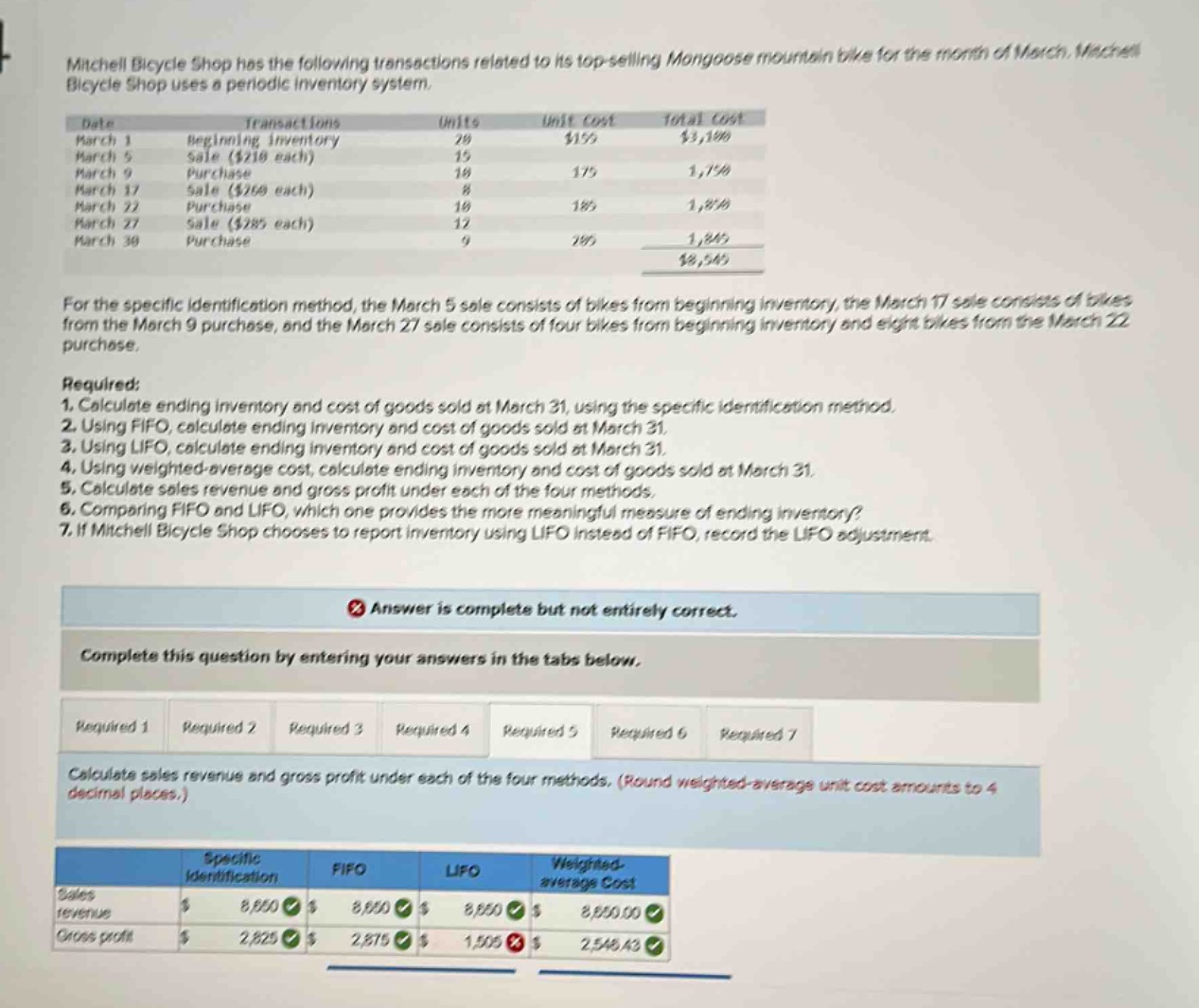
mitchell bicycle shop has the following transactions related to its top - selling mongoose mountain bike for the month of march. mitchell bicycle shop uses a periodic inventory system.\ndate transactions units unit cost total cost\nmarch 1 beginning inventory 20 $155 $3,100\nmarch 5 sale ($210 each) 15\nmarch 9 purchase 10 175 1,750\nmarch 17 sale ($260 each) 8\nmarch 22 purchase 10 185 1,850\nmarch 27 sale ($285 each) 12\nmarch 30 purchase 9 205 1,845\n$8,545\nfor the specific identification method, the march 5 sale consists of bikes from beginning inventory, the march 17 sale consists of bikes from the march 9 purchase, and the march 27 sale consists of four bikes from beginning inventory and eight bikes from the march 22 purchase.\nrequired:\n1. calculate ending inventory and cost of goods sold at march 31, using the specific identification method.\n2. using fifo, calculate ending inventory and cost of goods sold at march 31.\n3. using lifo, calculate ending inventory and cost of goods sold at march 31.\n4. using weighted - average cost, calculate ending inventory and cost of goods sold at march 31.\n5. calculate sales revenue and gross profit under each of the four methods.\n6. comparing fifo and lifo, which one provides the more meaningful measure of ending inventory?\n7. if mitchell bicycle shop chooses to report inventory using lifo instead of fifo, record the lifo adjustment.\nanswer is complete but not entirely correct.\ncomplete this question by entering your answers in the tabs below.\nrequired 1 required 2 required 3 required 4 required 5 required 6 required 7\ncalculate sales revenue and gross profit under each of the four methods. (round weighted - average unit cost amounts to 4 decimal places.)\nspecific identification fifo lifo weighted - average cost\nsales revenue $ 8,850 $ 8,850 $ 8,850 $ 8,850.00\ngross profit $ 2,825 $ 2,875 $ 1,505 $ 2,546.83
Answer
Explanation:
Step1: Calculate goods available for sale
Total units available = 20 + 10+ 10 + 9=49 Total cost of goods available = 3100+1750 + 1850+1845 = $8545
Step2: Calculate units sold
Units sold = 15 + 8+12=35
Step3: Calculate units in ending - inventory
Ending - inventory units = 49 - 35 = 14
Specific Identification Method
Step4: Cost of goods sold
March 5 sale (from beginning inventory): 15 units at $155 each, cost = 15×155 = $2325 March 17 sale (from March 9 purchase): 8 units at $175 each, cost = 8×175 = $1400 March 27 sale: 4 units from beginning inventory (4×155 = $620) and 8 units from March 22 purchase (8×185 = $1480) Total cost of goods sold = 2325+1400 + 620+1480=$5825
Step5: Ending inventory
Ending inventory cost = 8545 - 5825 = $2720
FIFO Method
Step6: Cost of goods sold
First 20 units from beginning inventory (20×155 = $3100) Then 10 units from March 9 purchase (10×175 = $1750) Then 5 units from March 22 purchase (5×185 = $925) Cost of goods sold = 3100+1750 + 925=$5775
Step7: Ending inventory
Ending inventory cost = 8545 - 5775 = $2770
LIFO Method
Step8: Cost of goods sold
First 9 units from March 30 purchase (9×205 = $1845) Then 10 units from March 22 purchase (10×185 = $1850) Then 8 units from March 9 purchase (8×175 = $1400) Then 8 units from beginning inventory (8×155 = $1240) Cost of goods sold = 1845+1850 + 1400+1240=$6335
Step9: Ending inventory
Ending inventory cost = 8545 - 6335 = $2210
Weighted - Average Cost Method
Step10: Calculate weighted - average unit cost
Weighted - average unit cost = $\frac{8545}{49}\approx174.3878$
Step11: Cost of goods sold
Cost of goods sold = 35×174.3878 = $6103.573
Step12: Ending inventory
Ending inventory cost = 8545 - 6103.573 = $2441.427
Sales Revenue
Total sales revenue = (15×210)+(8×260)+(12×285)=3150 + 2080+3420 = $8650
Gross Profit
- Specific Identification: Gross profit = 8650 - 5825 = $2825
- FIFO: Gross profit = 8650 - 5775 = $2875
- LIFO: Gross profit = 8650 - 6335 = $2315
- Weighted - Average: Gross profit = 8650 - 6103.573 = $2546.427
Answer to question 6
FIFO provides a more meaningful measure of ending inventory because the ending inventory is valued at the most recent purchase costs, which are closer to the current market value of inventory in a rising - price environment.
Answer to question 7
If switching from FIFO to LIFO, the inventory value decreases by 2770 - 2210 = $560. The journal entry for the LIFO adjustment: Debit: Cost of Goods Sold $560 Credit: Inventory $560
Answer:
- Specific Identification: Ending inventory = $2720, Cost of goods sold = $5825
- FIFO: Ending inventory = $2770, Cost of goods sold = $5775
- LIFO: Ending inventory = $2210, Cost of goods sold = $6335
- Weighted - average: Ending inventory = $2441.427, Cost of goods sold = $6103.573
- Sales revenue: $8650
- Specific Identification Gross profit: $2825
- FIFO Gross profit: $2875
- LIFO Gross profit: $2315
- Weighted - average Gross profit: $2546.427
- FIFO
- Debit: Cost of Goods Sold $560, Credit: Inventory $560