morris corporation uses the cost method to account for treasury stock transactions. as of june 30, the…
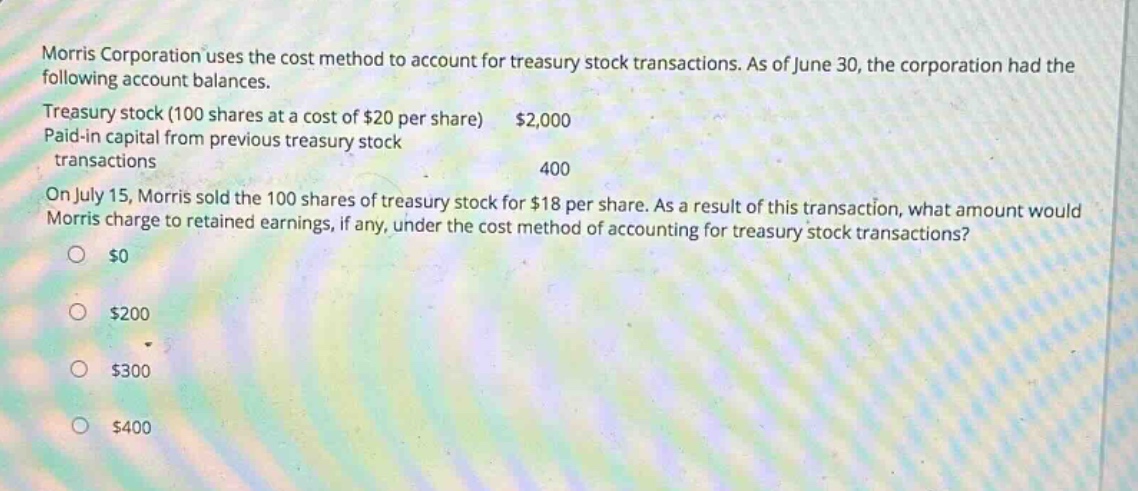
morris corporation uses the cost method to account for treasury stock transactions. as of june 30, the corporation had the following account balances. treasury stock (100 shares at a cost of $20 per share) $2,000 paid - in capital from previous treasury stock transactions 400 on july 15, morris sold the 100 shares of treasury stock for $18 per share. as a result of this transaction, what amount would morris charge to retained earnings, if any, under the cost method of accounting for treasury stock transactions? $0 $200 $300 $400
Answer
Explanation:
Step1: Calculate the cost of treasury - stock sold
The cost of 100 shares of treasury stock is $2,000 (100 shares * $20 per share).
Step2: Calculate the proceeds from the sale
The proceeds from selling 100 shares at $18 per share is $1,800 (100 * $18).
Step3: Determine the amount to be charged to retained earnings
First, use the paid - in capital from previous treasury stock transactions. The deficit on the sale of treasury stock is $2,000 - $1,800=$200. Since the paid - in capital from previous treasury stock transactions is $400 (which is greater than the $200 deficit), the entire $200 deficit will be charged against the paid - in capital from previous treasury stock transactions, and $0 will be charged to retained earnings.
Answer:
$0