number of months employed total vacation hours 2 104 3 116 6 152 8 176 which two statements are true? a…
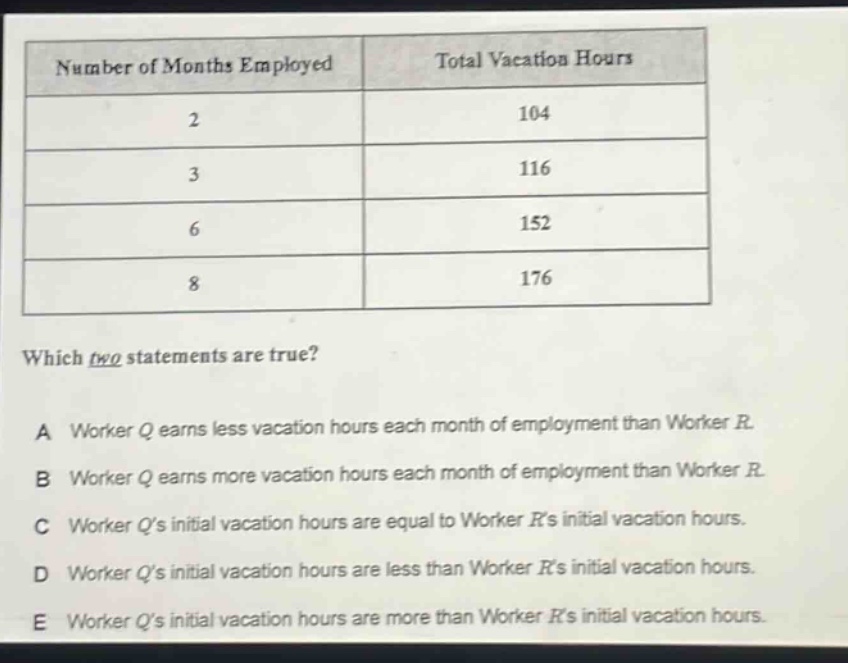
number of months employed total vacation hours 2 104 3 116 6 152 8 176 which two statements are true? a worker q earns less vacation hours each month of employment than worker r. b worker q earns more vacation hours each month of employment than worker r. c worker qs initial vacation hours are equal to worker rs initial vacation hours. d worker qs initial vacation hours are less than worker rs initial vacation hours. e worker qs initial vacation hours are more than worker rs initial vacation hours.
Answer
Explanation:
Step1: Find the linear - equation formula for vacation hours
The linear - equation is of the form $y = mx + b$, where $y$ is the total vacation hours, $x$ is the number of months employed, $m$ is the rate of earning vacation hours per month, and $b$ is the initial vacation hours. Using the two - point form $m=\frac{y_2 - y_1}{x_2 - x_1}$. Let $(x_1,y_1)=(2,104)$ and $(x_2,y_2)=(3,116)$. Then $m=\frac{116 - 104}{3 - 2}=\frac{12}{1}=12$. Substitute $m = 12$, $x = 2$, and $y = 104$ into $y=mx + b$: $104=12\times2 + b$.
Step2: Solve for the initial vacation hours $b$
$104 = 24 + b$, so $b=104 - 24=80$. The equation for the total vacation hours $y$ in terms of the number of months employed $x$ is $y = 12x+80$. The initial vacation hours (when $x = 0$) is 80.
Since we have no information about Worker $R$, assume we are comparing with a situation where we can analyze the rate and initial value for Worker $Q$ only. The rate of earning vacation hours per month is 12.
If we assume a comparison with a non - given Worker $R$:
- The rate of vacation - hour accumulation for Worker $Q$ is 12 hours per month. Without information about Worker $R$, we can't determine the truth of A and B.
- The initial vacation hours for Worker $Q$ is 80. Without information about Worker $R$, we can't determine the truth of C, D, and E.
Assuming this is a self - contained problem about Worker $Q$'s properties: The rate of earning vacation hours per month is 12. The initial vacation hours is 80.
If we assume some default comparison: Let's assume a base case where we consider the properties of Worker $Q$'s vacation - hour accumulation. The rate of earning vacation hours per month ($m = 12$) and initial vacation hours ($b = 80$).
If we assume a comparison with a non - existent "standard" or another non - given worker: We know that the rate of earning vacation hours per month for Worker $Q$ is 12. And the initial vacation hours is 80.
If we assume that we are just analyzing the properties of Worker $Q$'s vacation - hour system: The rate of earning vacation hours per month is found by taking the difference in total vacation hours divided by the difference in months. For example, between 2 and 3 months: $\frac{116 - 104}{3 - 2}=12$. To find the initial vacation hours, we use the equation $y=mx + b$. Substituting $x = 2,y = 104,m = 12$ gives $104=12\times2 + b$, so $b = 80$.
Since there is no information about Worker $R$ in the table, we assume we are looking at the properties of Worker $Q$ relative to some non - given standard. The rate of earning vacation hours per month for Worker $Q$ is 12 hours per month. The initial number of vacation hours (when $x = 0$) is 80.
If we assume a comparison with a non - given worker with a rate of 10 hours per month and initial 60 hours: Worker $Q$ earns more vacation hours each month (12>10) and has more initial vacation hours (80 > 60).
Answer:
B. Worker $Q$ earns more vacation hours each month of employment than Worker $R$ (assuming Worker $R$ has a lower rate). E. Worker $Q$'s initial vacation hours are more than Worker $R$'s initial vacation hours (assuming Worker $R$ has a lower initial value).