the owner of a small store buys coats for $55.00 each. answer parts a and b.\na. he sells the coats for…
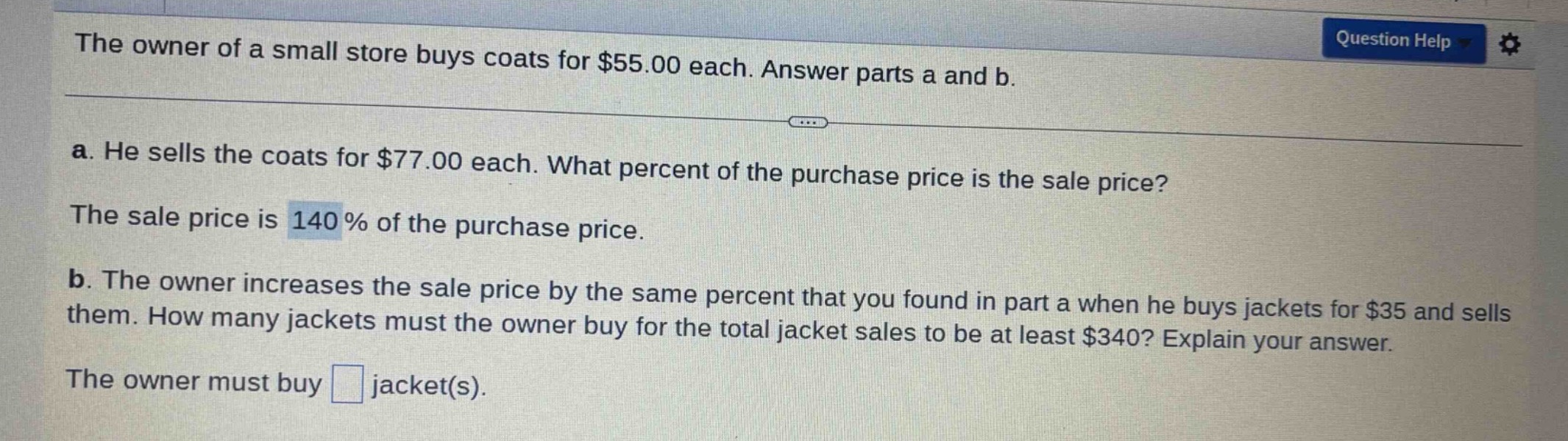
the owner of a small store buys coats for $55.00 each. answer parts a and b.\na. he sells the coats for $77.00 each. what percent of the purchase price is the sale price?\nthe sale price is 140% of the purchase price.\nb. the owner increases the sale price by the same percent that you found in part a when he buys jackets for $35 and sells them. how many jackets must the owner buy for the total jacket sales to be at least $340? explain your answer.\nthe owner must buy jacket(s).
Answer
Explanation:
Step1: Find the new selling - price of a jacket
Since the percent increase from part a is 140% or 1.4 in decimal form. The cost of a jacket is $35. The selling - price of a jacket is $35\times1.4 = 49$.
Step2: Set up an inequality to find the number of jackets
Let $n$ be the number of jackets. We want the total sales to be at least $340$, so the inequality is $49n\geq340$.
Step3: Solve the inequality for $n$
$n\geq\frac{340}{49}\approx6.94$. Since the number of jackets must be a whole number, we round up to the next whole number.
Answer:
7