1 from a physical count of merchandise inventory, the december 31 balance is determined to be $83,205.00…
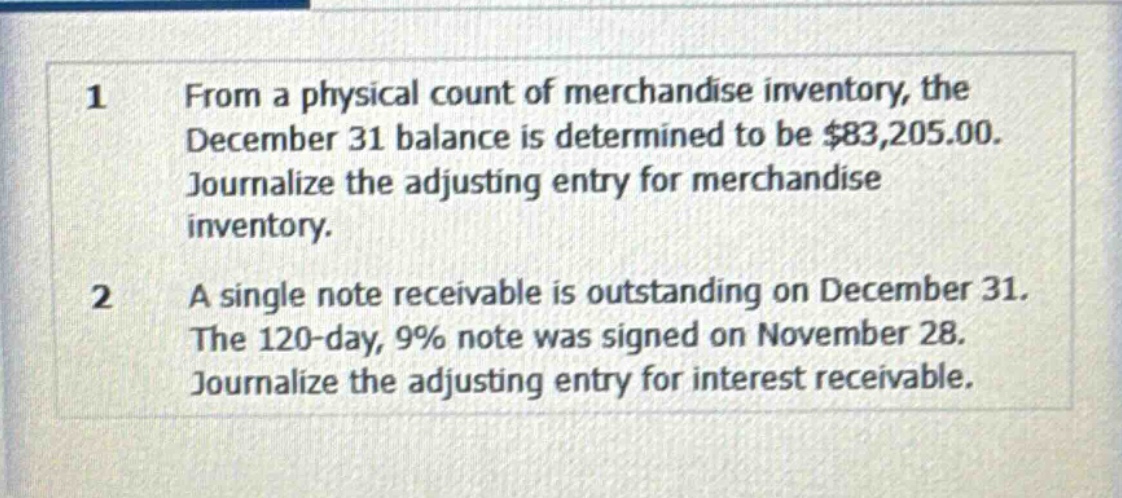
1 from a physical count of merchandise inventory, the december 31 balance is determined to be $83,205.00. journalize the adjusting entry for merchandise inventory.\n2 a single note receivable is outstanding on december 31. the 120 - day, 9% note was signed on november 28. journalize the adjusting entry for interest receivable.
Answer
Explanation:
Step1: Determine adjusting entry for merchandise inventory
Assume the previous balance in inventory account needs adjustment to the physical - count value. Debit Merchandise Inventory for the increase in value and credit Cost of Goods Sold (if the inventory was previously over - stated in COGS calculations) or an appropriate income - statement account. Debit: Merchandise Inventory $83,205 Credit: Cost of Goods Sold $83,205
Step2: Calculate interest for note receivable
First, calculate the number of days from November 28 to December 31. November has 30 days, so from November 28 to November 30 is 2 days, and December has 31 days, so a total of 33 days. The interest formula is $I = P\times r\times t$, where $P$ is the principal amount (not given, assume $P$), $r$ is the annual interest rate ($r = 0.09$), and $t$ is the time in years ($t=\frac{33}{360}$ assuming a 360 - day year for simplicity in business calculations). Interest $I = P\times0.09\times\frac{33}{360}$ The adjusting entry for interest receivable: Debit: Interest Receivable ($P\times0.09\times\frac{33}{360}$) Credit: Interest Revenue ($P\times0.09\times\frac{33}{360}$)
Answer:
- Debit: Merchandise Inventory $83,205; Credit: Cost of Goods Sold $83,205
- Debit: Interest Receivable ($P\times0.09\times\frac{33}{360}$); Credit: Interest Revenue ($P\times0.09\times\frac{33}{360}$) (where $P$ is the principal amount of the note receivable)