a plant in alamo, tn, manufactures complex transformer components that must meet specific guidelines for…
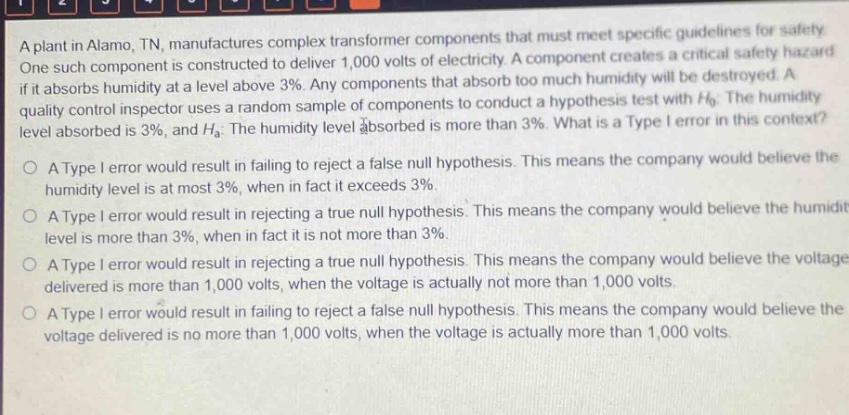
a plant in alamo, tn, manufactures complex transformer components that must meet specific guidelines for safety. one such component is constructed to deliver 1,000 volts of electricity. a component creates a critical safety hazard if it absorbs humidity at a level above 3%. any components that absorb too much humidity will be destroyed. a quality - control inspector uses a random sample of components to conduct a hypothesis test with $h_0$: the humidity level absorbed is 3%, and $h_a$: the humidity level absorbed is more than 3%. what is a type i error in this context?\no a type i error would result in failing to reject a false null hypothesis. this means the company would believe the humidity level is at most 3%, when in fact it exceeds 3%.\no a type i error would result in rejecting a true null hypothesis. this means the company would believe the humidity level is more than 3%, when in fact it is not more than 3%.\no a type i error would result in rejecting a true null hypothesis. this means the company would believe the voltage delivered is more than 1,000 volts, when the voltage is actually not more than 1,000 volts.\no a type i error would result in failing to reject a false null hypothesis. this means the company would believe the voltage delivered is no more than 1,000 volts, when the voltage is actually more than 1,000 volts.
Answer
Brief Explanations:
A Type I error occurs when we reject a true null hypothesis. In this context, the null hypothesis $H_0$ is that the humidity level absorbed is 3% and the alternative hypothesis $H_a$ is that the humidity level absorbed is more than 3%. So a Type I error means rejecting the true null hypothesis, believing the humidity level is more than 3% when in fact it is not more than 3%.
Answer:
A Type I error would result in rejecting a true null hypothesis. This means the company would believe the humidity level is more than 3%, when in fact it is not more than 3%.