primary question:\n• how can strategic leadership, viewed through the lens of servant leadership, be…
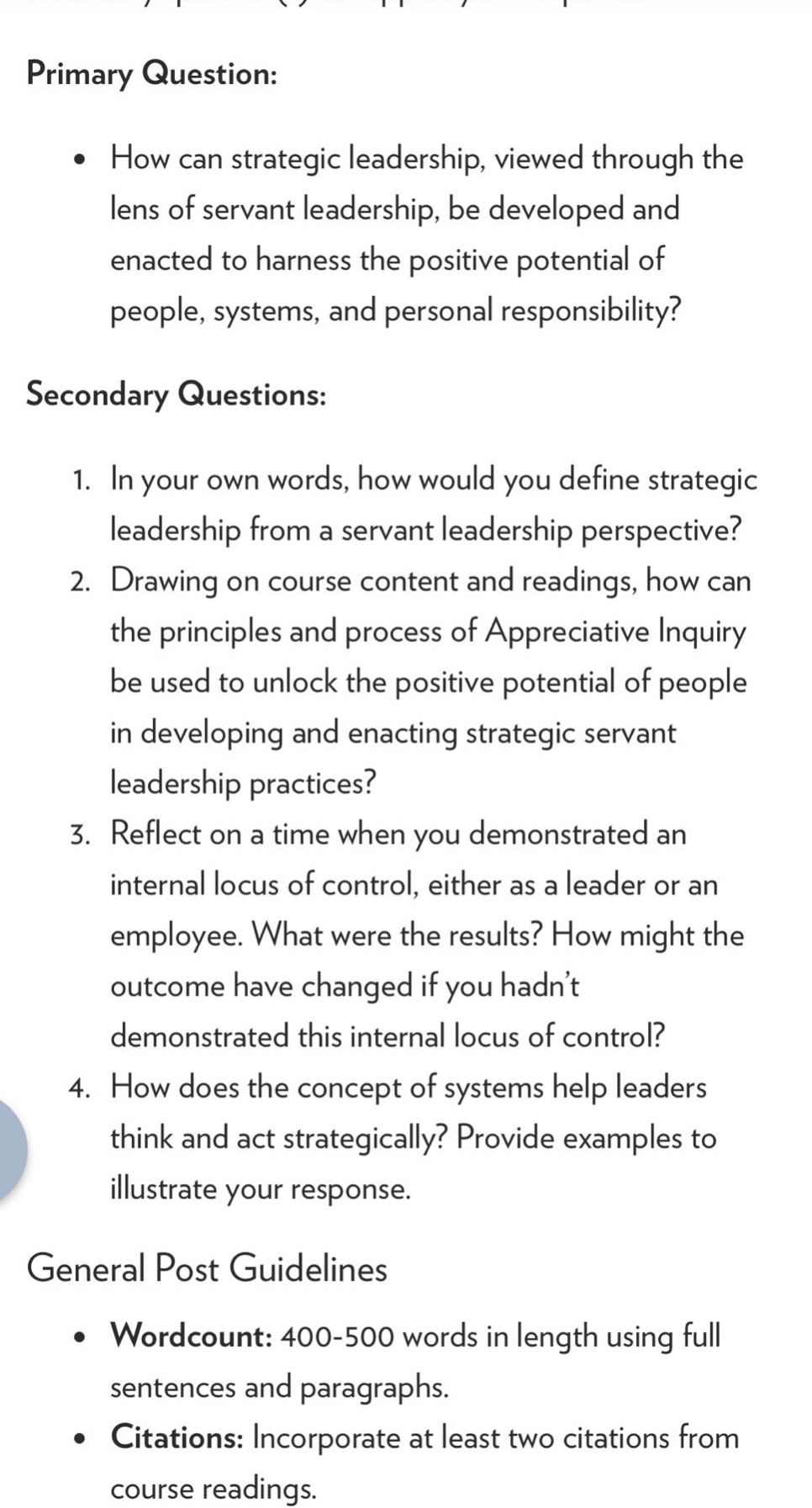
primary question:\n• how can strategic leadership, viewed through the lens of servant leadership, be developed and enacted to harness the positive potential of people, systems, and personal responsibility?\n\nsecondary questions:\n1. in your own words, how would you define strategic leadership from a servant leadership perspective?\n2. drawing on course content and readings, how can the principles and process of appreciative inquiry be used to unlock the positive potential of people in developing and enacting strategic servant leadership practices?\n3. reflect on a time when you demonstrated an internal locus of control, either as a leader or an employee. what were the results? how might the outcome have changed if you hadn’t demonstrated this internal locus of control?\n4. how does the concept of systems help leaders think and act strategically? provide examples to illustrate your response.\n\ngeneral post guidelines\n• wordcount: 400 - 500 words in length using full sentences and paragraphs.\n• citations: incorporate at least two citations from course readings.
Answer
Brief Explanations:
- Strategic leadership from a servant - leadership perspective emphasizes serving followers while formulating and implementing strategies. It focuses on the well - being and growth of people within the strategic context (Greenleaf, 1977).
- Appreciative Inquiry's principles of focusing on the positive, building on strengths, and engaging in collaborative dialogue can unlock people's positive potential. By identifying what is working well, leaders can create a shared vision and mobilize efforts towards strategic goals (Cooperrider & Whitney, 2005).
- Demonstrating an internal locus of control as a leader or employee means believing one has control over outcomes. For example, a leader who takes initiative to solve a problem may inspire the team and lead to better results. Without it, the leader might wait for external factors to change, resulting in inaction.
- The concept of systems helps leaders think holistically. For instance, in a business, understanding how different departments (sub - systems) interact can lead to strategic decisions. A leader may realize that improving communication between sales and production (two sub - systems) can enhance overall performance.
Answer:
- Strategic leadership from a servant - leadership perspective is about leading with a focus on serving followers' needs while driving strategic initiatives for the betterment of the organization and its people.
- Appreciative Inquiry can be used by identifying positive core elements in the organization and involving people in envisioning and creating a better future, thus unlocking their positive potential in strategic servant - leadership.
- When I took the initiative as a leader to address a project setback (internal locus of control), it motivated the team and we found a creative solution. Without it, the setback might have lingered and demotivated the team.
- In a manufacturing company, understanding the system of supply chain, production, and distribution helps leaders make strategic decisions like inventory management and production scheduling to optimize overall performance.