reading comprehension at work\nbusiness management and administration\ndirections: read the passage, read…
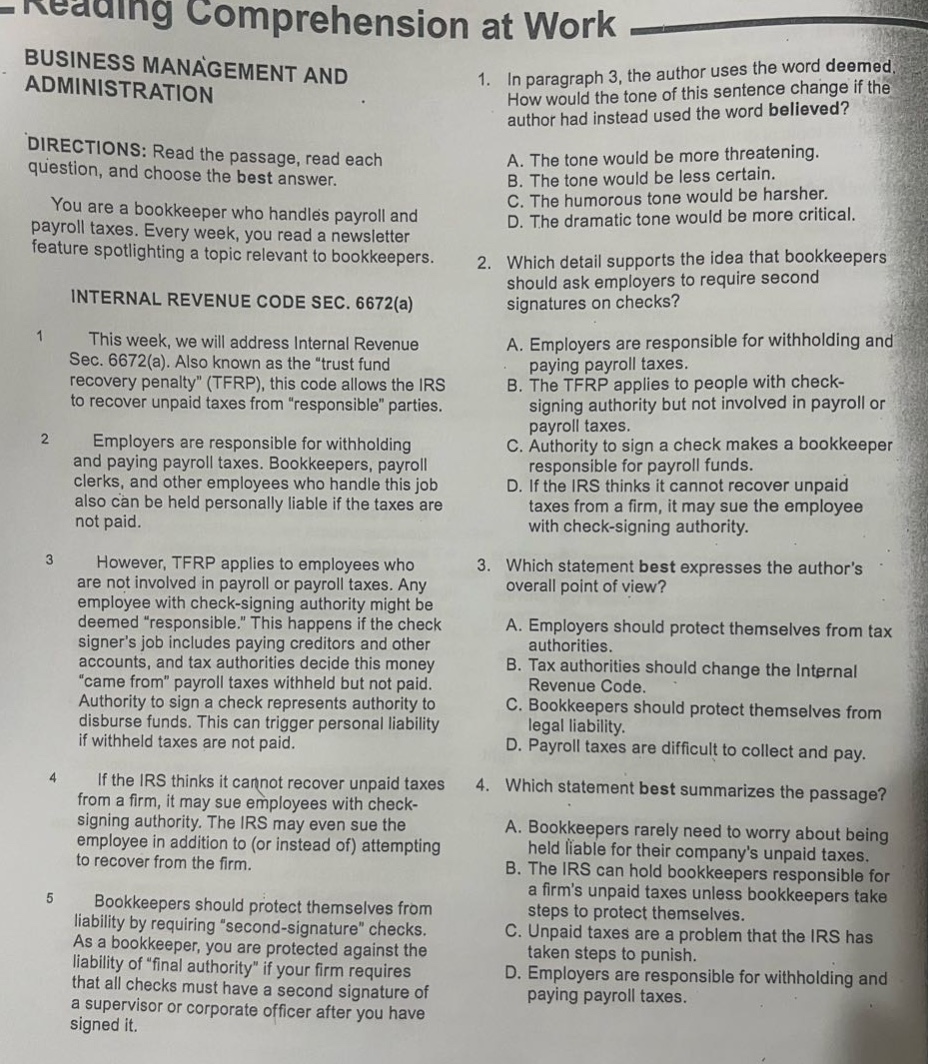
reading comprehension at work\nbusiness management and administration\ndirections: read the passage, read each question, and choose the best answer.\nyou are a bookkeeper who handles payroll and payroll taxes. every week, you read a newsletter feature spotlighting a topic relevant to bookkeepers.\ninternal revenue code sec. 6672(a)\n1 this week, we will address internal revenue sec. 6672(a). also known as the “trust fund recovery penalty” (tfrp), this code allows the irs to recover unpaid taxes from “responsible” parties.\n2 employers are responsible for withholding and paying payroll taxes. bookkeepers, payroll clerks, and other employees who handle this job also can be held personally liable if the taxes are not paid.\n3 however, tfrp applies to employees who are not involved in payroll or payroll taxes. any employee with check - signing authority might be deemed “responsible.” this happens if the check signer’s job includes paying creditors and other accounts, and tax authorities decide this money “came from” payroll taxes withheld but not paid. authority to sign a check represents authority to disburse funds. this can trigger personal liability if the taxes are not paid.\n4 if the irs thinks it cannot recover unpaid taxes from a firm, it may sue employees with check - signing authority. the irs may even sue the employee in addition to (or instead of) attempting to recover from the firm.\n5 bookkeepers should protect themselves from liability by requiring “second - signature” checks. as a bookkeeper, you are protected against the liability of “final authority” if your firm requires that all checks must have a second signature of a supervisor or corporate officer after you have signed it.\n1. in paragraph 3, the author uses the word deemed. how would the tone of this sentence change if the author had instead used the word believed?\na. the tone would be more threatening.\nb. the tone would be less certain.\nc. the humorous tone would be harsher.\nd. the dramatic tone would be more critical.\n2. which detail supports the idea that bookkeepers should ask employers to require second signatures on checks?\na. employers are responsible for withholding and paying payroll taxes.\nb. the tfrp applies to people with check - signing authority but not involved in payroll or payroll taxes.\nc. authority to sign a check makes a bookkeeper responsible for payroll funds.\nd. if the irs thinks it cannot recover unpaid taxes from a firm, it may sue the employee with check - signing authority.\n3. which statement best expresses the author’s overall point of view?\na. employers should protect themselves from tax authorities.\nb. tax authorities should change the internal revenue code.\nc. bookkeepers should protect themselves from legal liability.\nd. payroll taxes are difficult to collect and pay.\n4. which statement best summarizes the passage?\na. bookkeepers rarely need to worry about being held liable for their company’s unpaid taxes.\nb. the irs can hold bookkeepers responsible for a firm’s unpaid taxes unless bookkeepers take steps to protect themselves.\nc. unpaid taxes are a problem that the irs has taken steps to punish.\nd. employers are responsible for withholding and paying payroll taxes.
Answer
Brief Explanations:
- "Deemed" implies an official, certain determination, while "believed" suggests a more subjective, less - certain view. So using "believed" would make the tone less certain.
- The fact that the IRS may sue employees with check - signing authority if unpaid taxes can't be recovered from the firm shows why bookkeepers should ask for second signatures to protect themselves.
- The passage focuses on how bookkeepers can protect themselves from legal liability related to unpaid payroll taxes, such as by using second - signature checks.
- The passage mainly discusses how the IRS can hold bookkeepers responsible for a firm's unpaid taxes and how bookkeepers can protect themselves.
Answer:
- B. The tone would be less certain.
- D. If the IRS thinks it cannot recover unpaid taxes from a firm, it may sue the employee with check - signing authority.
- C. Bookkeepers should protect themselves from legal liability.
- B. The IRS can hold bookkeepers responsible for a firm's unpaid taxes unless bookkeepers take steps to protect themselves.