refer to the project described by the project digraph shown on the right. complete (a) through (d)…
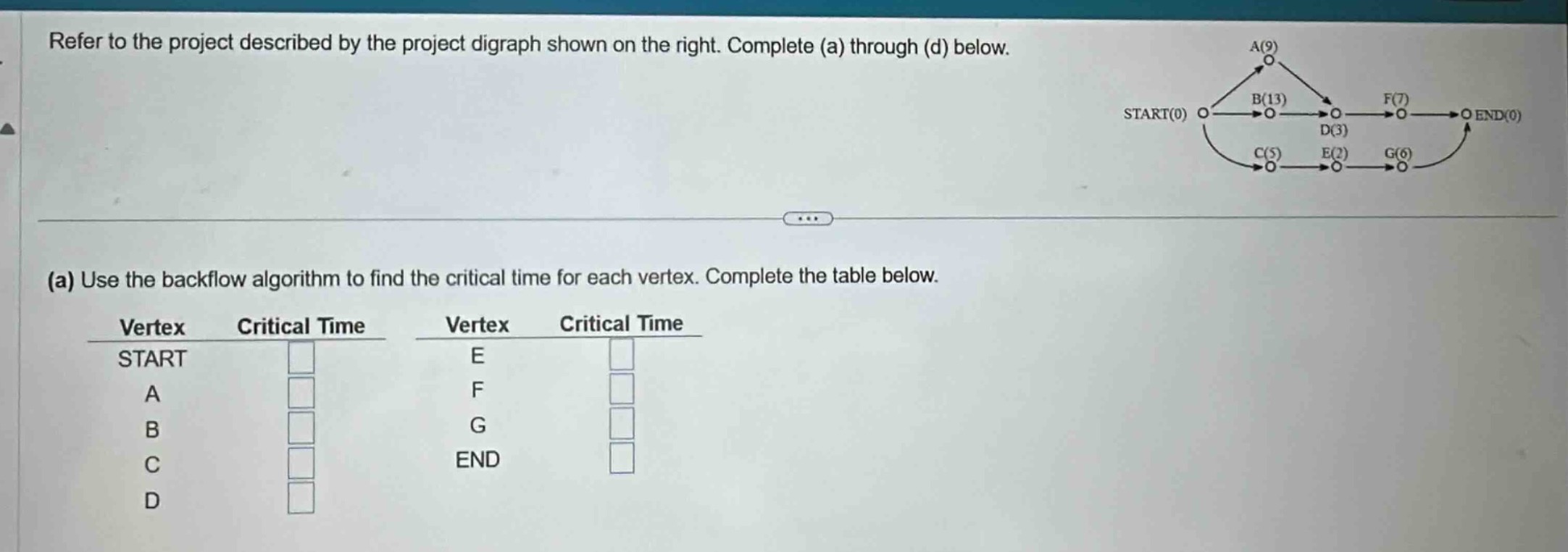
refer to the project described by the project digraph shown on the right. complete (a) through (d) below.\n(a) use the backflow algorithm to find the critical time for each vertex. complete the table below.\n| vertex | critical time | vertex | critical time |\n| ---- | ---- | ---- | ---- |\n| start | | e | |\n| a | | f | |\n| b | | g | |\n| c | | end | |\n| d | | | |
Answer
Explanation:
Step1: Initialize END time
The END vertex has a critical - time of 0. Let $T_{END}=0$.
Step2: Calculate G time
Since G points to END and the weight of the edge from G to END is 6, $T_G=T_{END}-6 = 0 - 6=-6$.
Step3: Calculate E time
Since E points to G and the weight of the edge from E to G is 2, $T_E=T_G - 2=-6 - 2=-8$.
Step4: Calculate C time
Since C points to E and the weight of the edge from C to E is 5, $T_C=T_E - 5=-8 - 5=-13$.
Step5: Calculate F time
Since F points to END and the weight of the edge from F to END is 7, $T_F=T_{END}-7 = 0 - 7=-7$.
Step6: Calculate D time
Since D has two outgoing edges to F and END. We consider the maximum of the time - calculations based on these edges. The time from D to F gives $T_{F}-3=-7 - 3=-10$ and the time from D to END is not relevant as it's not the maximum. So $T_D=-10$.
Step7: Calculate B time
Since B points to D and the weight of the edge from B to D is 13, $T_B=T_D - 13=-10 - 13=-23$.
Step8: Calculate A time
Since A points to B and the weight of the edge from A to B is 9, $T_A=T_B - 9=-23 - 9=-32$.
Step9: Calculate START time
Since START has outgoing edges to A, B and C. We consider the maximum of the time - calculations based on these edges. For the edge to A: $T_A=-32$, for the edge to B: $T_B=-23$, for the edge to C: $T_C=-13$. So $T_{START}=\max{-32,-23,-13}=-13$.
Answer:
| Vertex | Critical Time | Vertex | Critical Time |
|---|---|---|---|
| START | - 13 | E | - 8 |
| A | - 32 | F | - 7 |
| B | - 23 | G | - 6 |
| C | - 13 | END | 0 |
| D | - 10 |