a restaurant is introducing a new gluten - free recipe for the topping in its baked zucchini recipe. the…
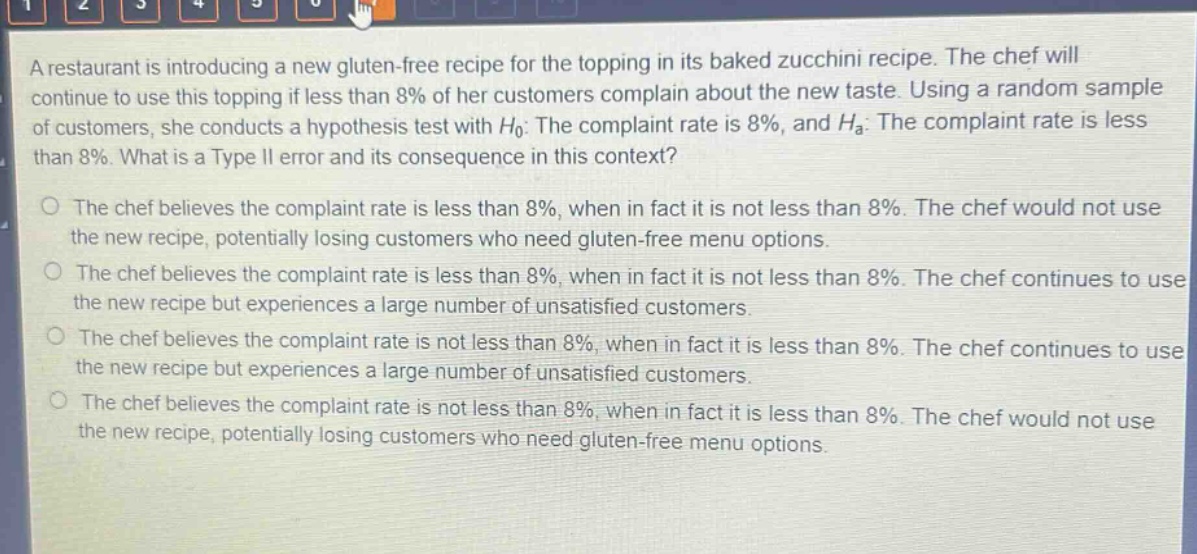
a restaurant is introducing a new gluten - free recipe for the topping in its baked zucchini recipe. the chef will continue to use this topping if less than 8% of her customers complain about the new taste. using a random sample of customers, she conducts a hypothesis test with $h_0$: the complaint rate is 8%, and $h_a$: the complaint rate is less than 8%. what is a type ii error and its consequence in this context?\no the chef believes the complaint rate is less than 8%, when in fact it is not less than 8%. the chef would not use the new recipe, potentially losing customers who need gluten - free menu options.\no the chef believes the complaint rate is less than 8%, when in fact it is not less than 8%. the chef continues to use the new recipe but experiences a large number of unsatisfied customers.\no the chef believes the complaint rate is not less than 8%, when in fact it is less than 8%. the chef continues to use the new recipe but experiences a large number of unsatisfied customers.\no the chef believes the complaint rate is not less than 8%, when in fact it is less than 8%. the chef would not use the new recipe, potentially losing customers who need gluten - free menu options.
Answer
Answer:
The chef believes the complaint rate is not less than 8%, when in fact it is less than 8%. The chef would not use the new recipe, potentially losing customers who need gluten - free menu options.
Brief Explanations:
A Type II error occurs when we fail to reject a false null hypothesis. Here, null is complaint rate is 8%. So failing to reject it when it's false (complaint rate is actually less) means chef won't use recipe and may lose customers wanting gluten - free items.