down the river canoe sold merchandise for cash to low rent tours for $150, plus sales tax of $11. the…
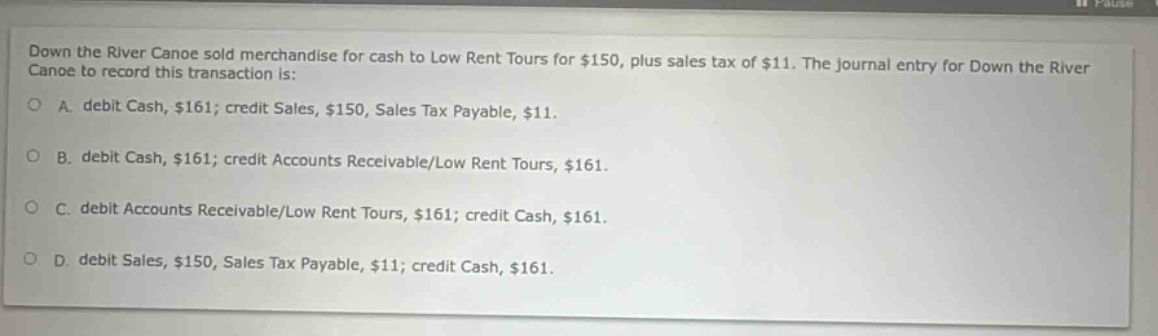
down the river canoe sold merchandise for cash to low rent tours for $150, plus sales tax of $11. the journal entry for down the river canoe to record this transaction is: a. debit cash, $161; credit sales, $150, sales tax payable, $11. b. debit cash, $161; credit accounts receivable/low rent tours, $161. c. debit accounts receivable/low rent tours, $161; credit cash, $161. d. debit sales, $150, sales tax payable, $11; credit cash, $161.
Answer
Answer:
A. debit Cash, $161; credit Sales, $150, Sales Tax Payable, $11.
Explanation:
Step1: Analyze cash received
The total cash received is the sum of the sales amount and sales - tax. So, $150 + 11=161$. Cash is an asset, and when it increases, we debit it for $161$.
Step2: Record sales amount
The sales amount of $150$ is a revenue. Revenues increase equity, and we credit the Sales account for $150$.
Step3: Record sales - tax liability
The sales tax of $11$ is a liability that the company owes to the tax authority. Liabilities increase on the credit side, so we credit Sales Tax Payable for $11$.