robertas monthly bank statement says that she has a balance of 386.29, but robertas check register says that…
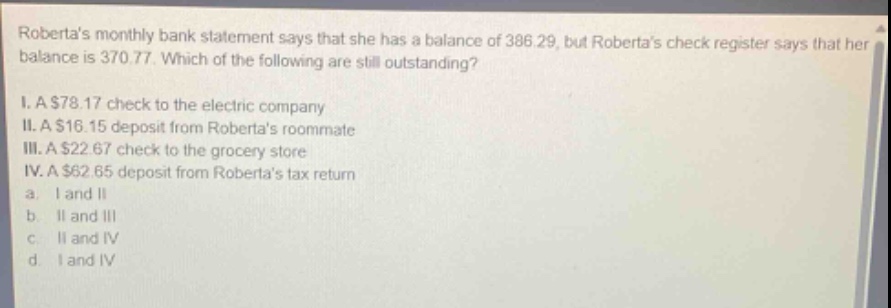
robertas monthly bank statement says that she has a balance of 386.29, but robertas check register says that her balance is 370.77. which of the following are still outstanding? i. a $78.17 check to the electric company ii. a $16.15 deposit from robertas roommate iii. a $22.67 check to the grocery store iv. a $62.65 deposit from robertas tax return a i and ii b ii and iii c ii and iv d i and iv
Answer
Explanation:
Step1: Find the difference in balances
The difference between the bank - statement balance and the check - register balance is $386.29−370.77 = 15.52$. Outstanding items will cause this difference. Deposits increase the balance and checks decrease the balance.
Step2: Analyze each item
Let's consider the effect of each item on the balance:
- For a $$78.17$ check to the electric company: If it is outstanding, it would decrease the check - register balance compared to the bank statement.
- For a $$16.15$ deposit from the roommate: If it is outstanding, it would increase the check - register balance compared to the bank statement.
- For a $$22.67$ check to the grocery store: If it is outstanding, it would decrease the check - register balance compared to the bank statement.
- For a $$62.65$ deposit from the tax return: If it is outstanding, it would increase the check - register balance compared to the bank statement. Let $x$ be the sum of outstanding deposits and $y$ be the sum of outstanding checks. The difference in balances is due to $x - y$. We want to find which combination of items will result in a difference of $15.52$. If we consider item II (a $$16.15$ deposit) and item III (a $$22.67$ check), the net effect is $16.15-22.67=- 6.52$. If we consider item I (a $$78.17$ check) and item IV (a $$62.65$ deposit), the net effect is $62.65 - 78.17=-15.52$.
Answer:
d. I and IV