section review 7c\n1. how did john marshall, chief justice of the supreme court, define a corporation?\n2…
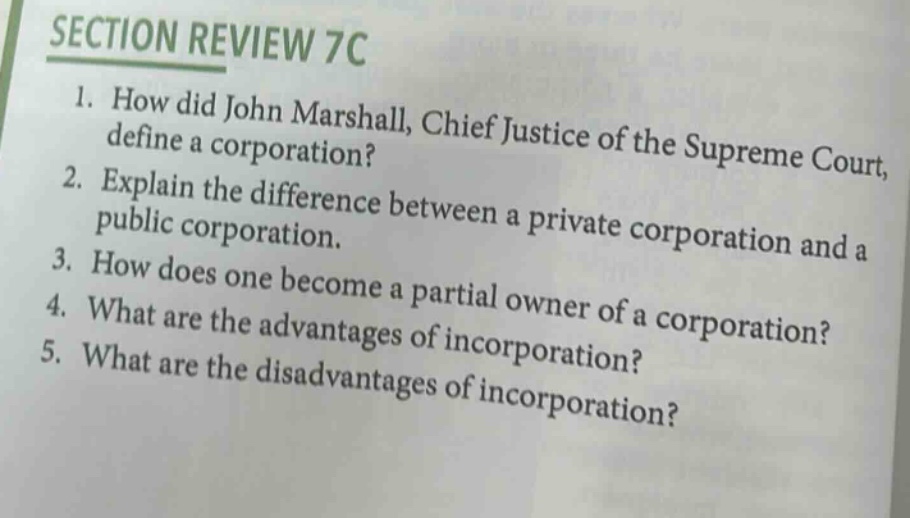
section review 7c\n1. how did john marshall, chief justice of the supreme court, define a corporation?\n2. explain the difference between a private corporation and a public corporation.\n3. how does one become a partial owner of a corporation?\n4. what are the advantages of incorporation?\n5. what are the disadvantages of incorporation?
Answer
Brief Explanations:
- John Marshall defined a corporation as an artificial being, invisible, intangible, and existing only in contemplation of law.
- A private corporation is owned by private individuals or entities for profit - making purposes. A public corporation is created by the government to provide public services or carry out public functions.
- One can become a partial owner of a corporation by purchasing shares of its stock.
- Advantages of incorporation include limited liability for shareholders, ease of raising capital through selling stocks or bonds, perpetual existence (not dependent on the life of individual owners), and professional management.
- Disadvantages of incorporation include double - taxation (corporate profits are taxed at the corporate level and then dividends are taxed at the shareholder level), more complex legal and regulatory requirements, and potential for agency problems (conflict between management and shareholders).
Answer:
- An artificial being, invisible, intangible, and existing only in contemplation of law.
- Private corporation: owned by private individuals/entities for profit. Public corporation: created by government for public services/functions.
- By purchasing shares of its stock.
- Limited liability, ease of raising capital, perpetual existence, professional management.
- Double - taxation, complex legal/regulatory requirements, potential agency problems.