select the correct answer from the drop - down menu.\nthe table shows the results from a survey of 335…
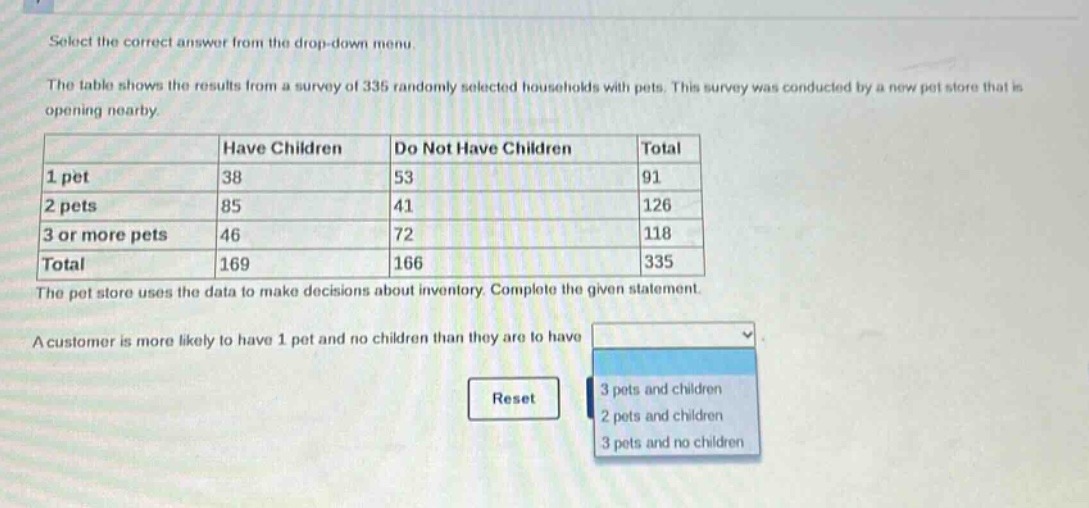
select the correct answer from the drop - down menu.\nthe table shows the results from a survey of 335 randomly selected households with pets. this survey was conducted by a new pet store that is opening nearby.\n| | have children | do not have children | total |\n|----|----|----|----|\n| 1 pet | 38 | 53 | 91 |\n| 2 pets | 85 | 41 | 126 |\n| 3 or more pets | 46 | 72 | 118 |\n| total | 169 | 166 | 335 |\nthe pet store uses the data to make decisions about inventory. complete the given statement.\na customer is more likely to have 1 pet and no children than they are to have\nreset\n3 pets and children\n2 pets and children\n3 pets and no children
Answer
Answer:
2 pets and children
Explanation:
Step1: Calculate probability of 1 pet and no children
The number of households with 1 pet and no children is 53. The total number of households is 335. So the probability $P(1\text{ pet}, \text{no children})=\frac{53}{335}\approx 0.158$.
Step2: Calculate probability of 3 pets and children
The number of households with 3 or more pets and children is 46. The probability $P(3\text{ or more pets}, \text{children})=\frac{46}{335}\approx 0.137$.
Step3: Calculate probability of 2 pets and children
The number of households with 2 pets and children is 85. The probability $P(2\text{ pets}, \text{children})=\frac{85}{335}\approx 0.254$.
Step4: Calculate probability of 3 pets and no children
The number of households with 3 or more pets and no children is 72. The probability $P(3\text{ or more pets}, \text{no children})=\frac{72}{335}\approx 0.215$. Since $0.254$ (probability of 2 pets and children) is greater than $0.158$ (probability of 1 pet and no children), a customer is more likely to have 1 pet and no children than they are to have 2 pets and children.