2. the senior class is having a fundraiser to help pay for the senior trip. selling a box of chocolates…
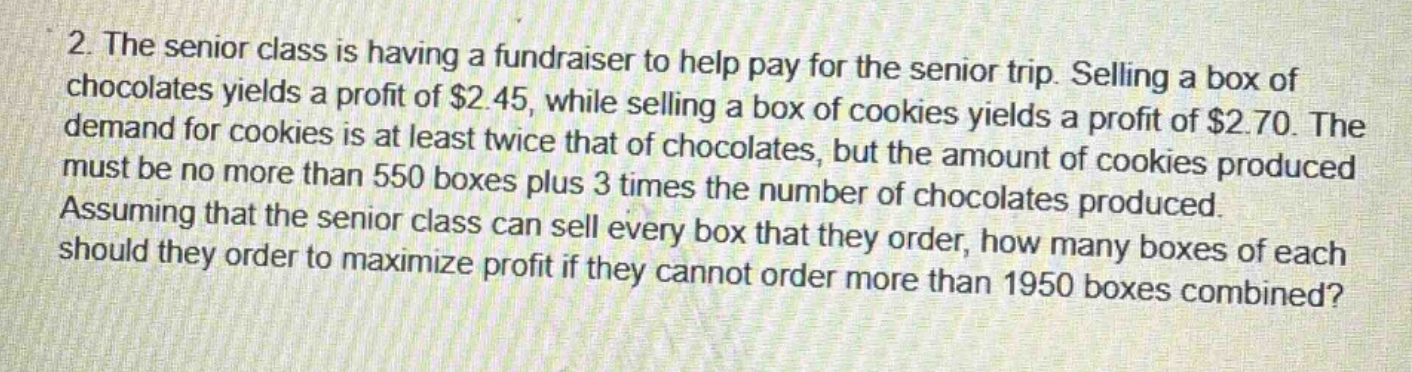
2. the senior class is having a fundraiser to help pay for the senior trip. selling a box of chocolates yields a profit of $2.45, while selling a box of cookies yields a profit of $2.70. the demand for cookies is at least twice that of chocolates, but the amount of cookies produced must be no more than 550 boxes plus 3 times the number of chocolates produced. assuming that the senior class can sell every box that they order, how many boxes of each should they order to maximize profit if they cannot order more than 1950 boxes combined?
Answer
Explanation:
Step1: Define variables
Let $x$ be the number of boxes of chocolates and $y$ be the number of boxes of cookies.
Step2: Set up constraints
- Demand - related constraint: $y\geq2x$.
- Production - related constraint: $y\leq3x + 550$.
- Quantity - related constraint: $x + y\leq1950$.
- Non - negativity constraints: $x\geq0,y\geq0$. Also, $x\leq1950,y\leq1950$.
Step3: Set up the objective function
The profit function $P$ is $P=2.45x + 2.70y$.
Step4: Find the corner points of the feasible region
- Solve the system of equations of the boundary lines:
- Intersection of $y = 2x$ and $x + y=1950$. Substitute $y = 2x$ into $x + y=1950$, we get $x+2x=1950$, so $3x=1950$ and $x = 650$, then $y=1300$.
- Intersection of $y = 3x + 550$ and $x + y=1950$. Substitute $y=3x + 550$ into $x + y=1950$, we have $x+(3x + 550)=1950$, $4x=1950 - 550=1400$, $x = 350$, and $y=3\times350+550=1050 + 550 = 1600$. But since $y\leq1950$ and $x\leq1950$, this point is valid.
- Intersection of $y = 2x$ and $y=3x + 550$ gives $2x=3x + 550$, $x=-550$ (not valid as $x\geq0$).
- Intersection of $y = 3x+550$ and $y = 1950$ gives $1950=3x + 550$, $3x=1950 - 550 = 1400$, $x=\frac{1400}{3}\approx466.67$.
- Intersection of $x = 1950$ and $x + y=1950$ gives $y = 0$.
- Intersection of $y = 1950$ and $x + y=1950$ gives $x = 0$.
Step5: Evaluate the objective function at corner points
- At $(x = 650,y = 1300)$: $P=2.45\times650+2.70\times1300=1592.5+3510=5102.5$.
- At $(x = 350,y = 1600)$: $P=2.45\times350+2.70\times1600=857.5+4320=5177.5$.
- At $(x = 0,y = 0)$: $P=0$.
- At $(x = 1950,y = 0)$: $P=2.45\times1950=4777.5$.
- At $(x = 0,y = 1950)$: $P=2.70\times1950=5265$.
Answer:
They should order 0 boxes of chocolates and 1950 boxes of cookies.