the store owner converts the frequency table to a conditional relative frequency table by row. beach towel…
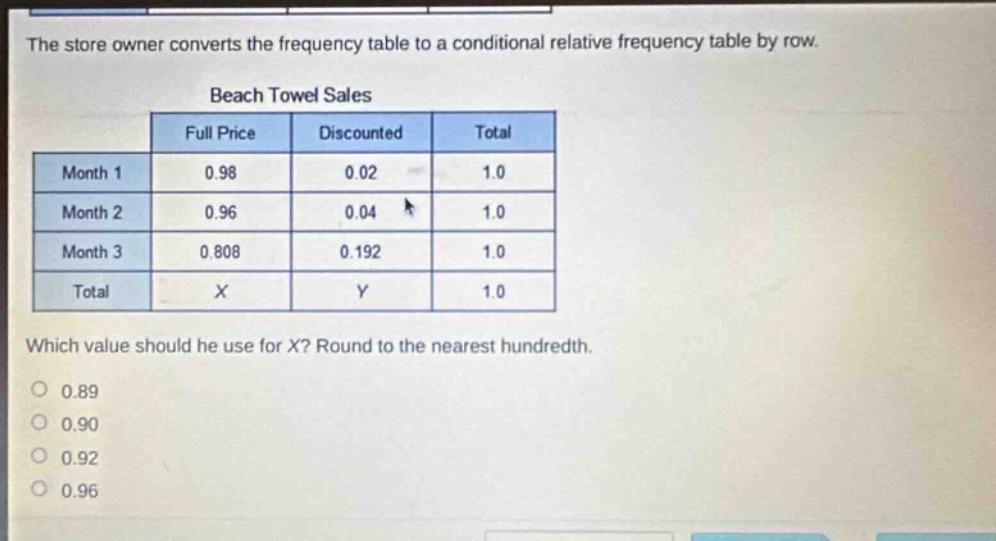
the store owner converts the frequency table to a conditional relative frequency table by row. beach towel sales full price discounted total month 1 0.98 0.02 1.0 month 2 0.96 0.04 1.0 month 3 0.808 0.192 1.0 total x y 1.0 which value should he use for x? round to the nearest hundredth. 0.89 0.90 0.92 0.96
Answer
Explanation:
Step1: Recall conditional - relative frequency concept
In a conditional relative - frequency table by row, to find the total for the 'Full Price' column ($X$), we need to take the weighted average of the full - price conditional relative frequencies for each month. Let's assume the number of sales in each month is the same (since we are dealing with relative frequencies). We can calculate $X$ as the average of the full - price conditional relative frequencies for Month 1, Month 2, and Month 3.
Step2: Calculate the average
$X=\frac{0.98 + 0.96+0.808}{3}$ $X=\frac{2.748}{3}$ $X = 0.916$ Rounding $0.916$ to the nearest hundredth gives $0.92$.
Answer:
0.92