suppose a manufacturer of printed circuits has a stock of 200 resistors, 120 transistors and 150 capacitors…
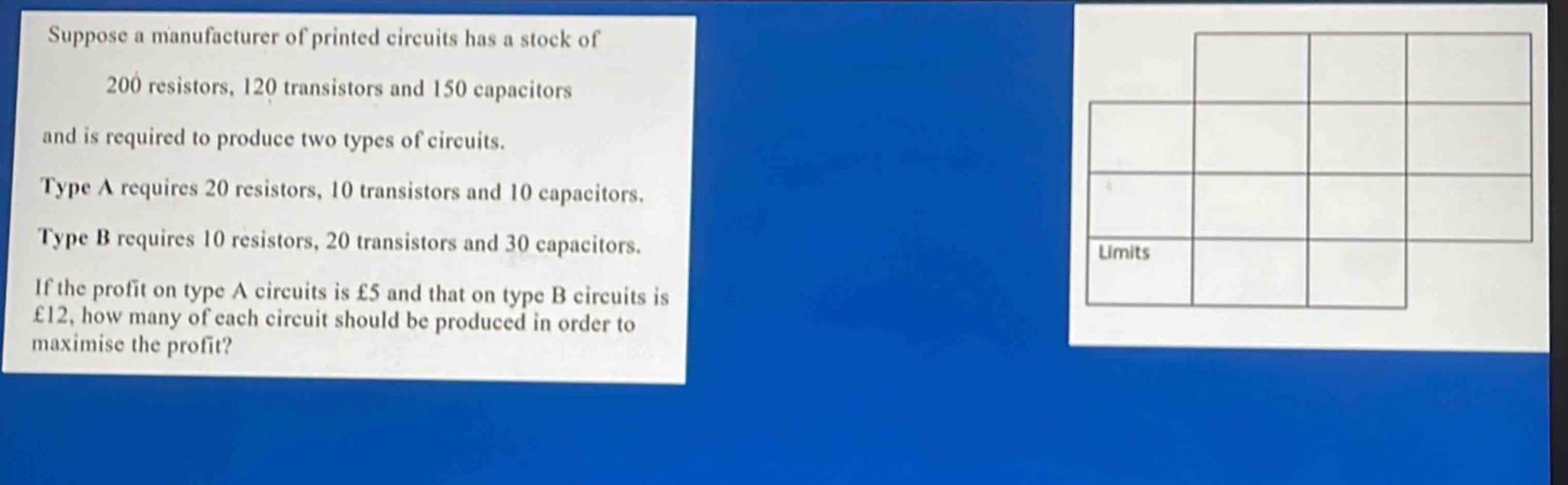
suppose a manufacturer of printed circuits has a stock of 200 resistors, 120 transistors and 150 capacitors and is required to produce two types of circuits. type a requires 20 resistors, 10 transistors and 10 capacitors. type b requires 10 resistors, 20 transistors and 30 capacitors. if the profit on type a circuits is £5 and that on type b circuits is £12, how many of each circuit should be produced in order to maximise the profit?
Answer
Explanation:
Step1: Define variables
Let $x$ be the number of type - A circuits and $y$ be the number of type - B circuits.
Step2: Set up constraints
Resistor constraint: $20x + 10y\leqslant200\Rightarrow2x + y\leqslant20$. Transistor constraint: $10x+20y\leqslant120\Rightarrow x + 2y\leqslant12$. Capacitor constraint: $10x + 30y\leqslant150\Rightarrow x+3y\leqslant15$. Also, $x\geqslant0,y\geqslant0$ (non - negative production).
Step3: Define the objective function
The profit function $P = 5x+12y$.
Step4: Find the corner points of the feasible region
Solve the systems of equations:
- Intersection of $x = 0$ and $y = 0$ gives the point $(0,0)$.
- Intersection of $x=0$ and $x + 2y=12$: Substitute $x = 0$ into $x + 2y=12$, we get $y = 6$, so the point is $(0,6)$.
- Intersection of $y = 0$ and $2x + y=20$: Substitute $y = 0$ into $2x + y=20$, we get $x = 10$, so the point is $(10,0)$.
- Solve the system $\begin{cases}2x + y=20\x + 2y=12\end{cases}$. From the first equation $y=20 - 2x$. Substitute into the second: $x + 2(20 - 2x)=12$, $x+40-4x=12$, $- 3x=-28$, $x=\frac{28}{3}$, $y=20-2\times\frac{28}{3}=20-\frac{56}{3}=\frac{4}{3}$.
- Solve the system $\begin{cases}x + 2y=12\x+3y=15\end{cases}$. Subtract the first equation from the second: $(x + 3y)-(x + 2y)=15 - 12$, $y = 3$. Substitute $y = 3$ into $x+2y=12$ gives $x=6$.
- Solve the system $\begin{cases}2x + y=20\x+3y=15\end{cases}$. From the first equation $y=20 - 2x$. Substitute into the second: $x+3(20 - 2x)=15$, $x + 60-6x=15$, $-5x=-45$, $x = 9$, $y=20-2\times9 = 2$.
Step5: Evaluate the objective function at corner points
- At $(0,0)$: $P(0,0)=5\times0 + 12\times0=0$.
- At $(0,6)$: $P(0,6)=5\times0+12\times6 = 72$.
- At $(10,0)$: $P(10,0)=5\times10+12\times0 = 50$.
- At $(\frac{28}{3},\frac{4}{3})$: $P(\frac{28}{3},\frac{4}{3})=5\times\frac{28}{3}+12\times\frac{4}{3}=\frac{140 + 48}{3}=\frac{188}{3}\approx62.67$.
- At $(6,3)$: $P(6,3)=5\times6+12\times3=30 + 36=66$.
- At $(9,2)$: $P(9,2)=5\times9+12\times2=45+24 = 69$.
Answer:
9 type - A circuits and 2 type - B circuits should be produced to maximize the profit.