tax returns filed manually have a 20% chance of containing errors, while tax returns filed electronically…
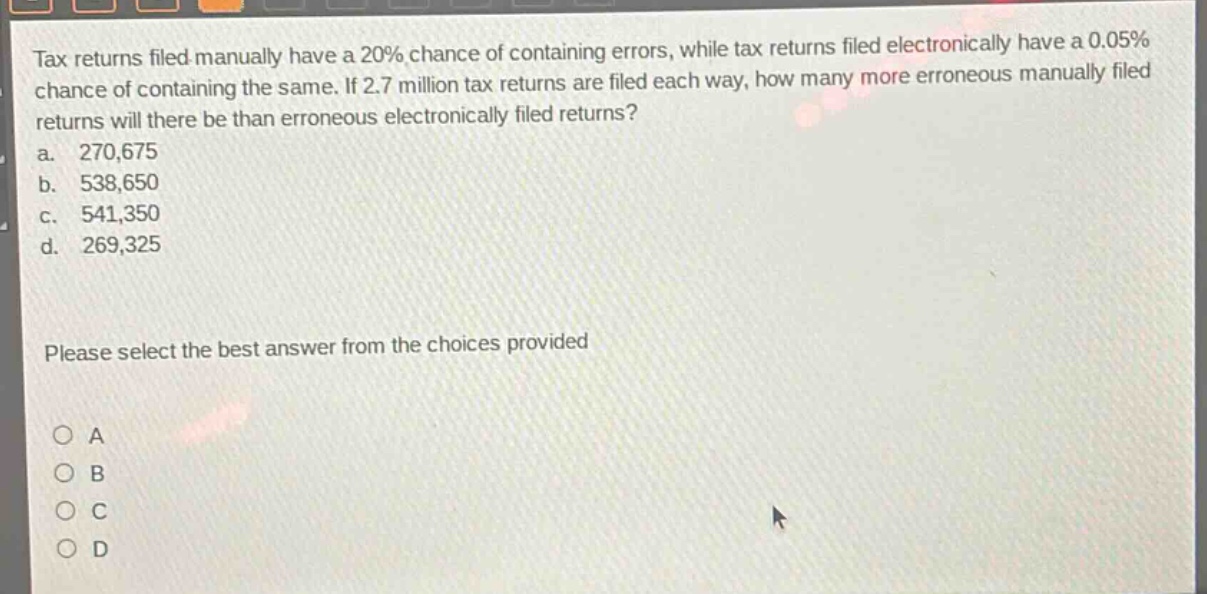
tax returns filed manually have a 20% chance of containing errors, while tax returns filed electronically have a 0.05% chance of containing the same. if 2.7 million tax returns are filed each way, how many more erroneous manually filed returns will there be than erroneous electronically filed returns?\na. 270,675\nb. 538,650\nc. 541,350\nd. 269,325\nplease select the best answer from the choices provided\no a\no b\no c\no d
Answer
Explanation:
Step1: Calculate number of erroneous manually - filed returns
The number of manually - filed returns is 2.7 million ($2700000$). The error rate for manually - filed returns is 20% or 0.2. So the number of erroneous manually - filed returns is $2700000\times0.2 = 540000$.
Step2: Calculate number of erroneous electronically - filed returns
The number of electronically - filed returns is 2.7 million ($2700000$). The error rate for electronically - filed returns is 0.05% or 0.0005. So the number of erroneous electronically - filed returns is $2700000\times0.0005=1350$.
Step3: Calculate the difference
Subtract the number of erroneous electronically - filed returns from the number of erroneous manually - filed returns: $540000 - 1350=538650$.
Answer:
B. 538,650