a television manufacturer makes qled and oled televisions. the profit per unit is $120 for the qled…
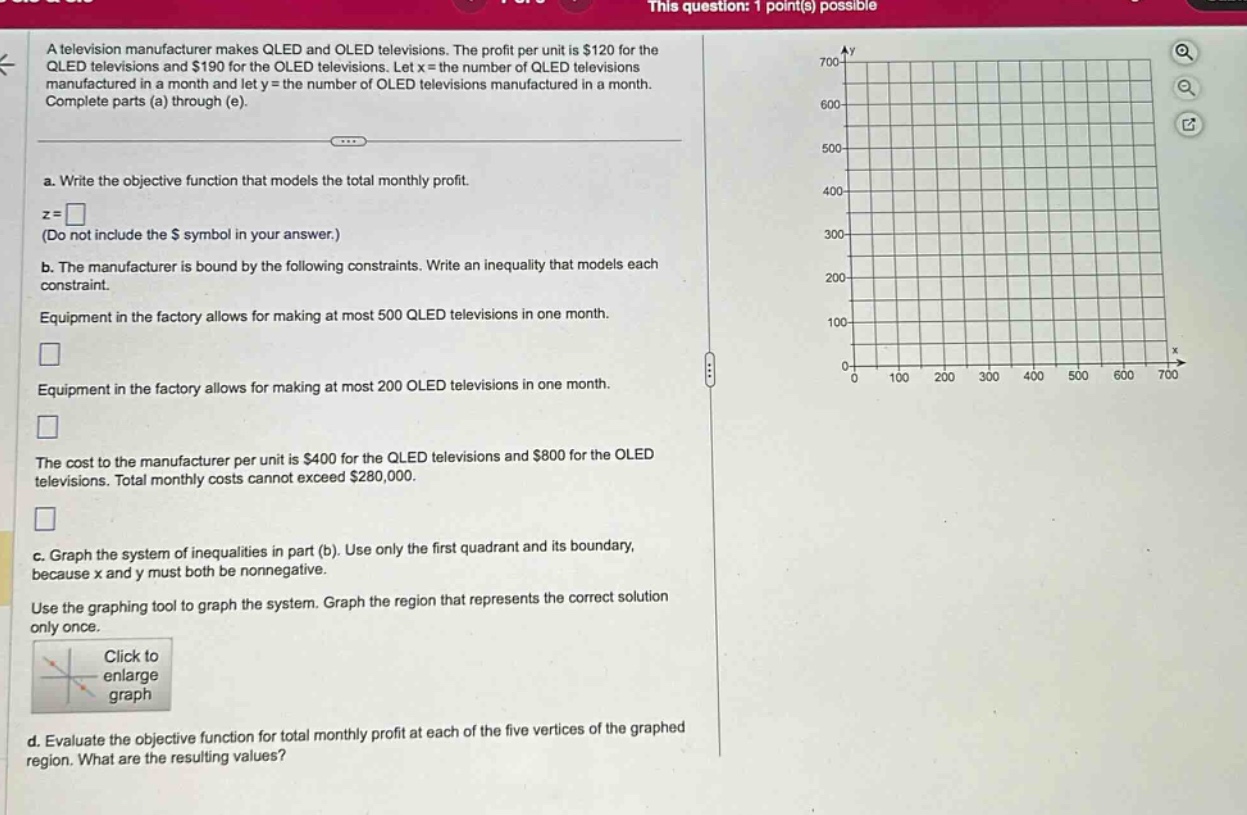
a television manufacturer makes qled and oled televisions. the profit per unit is $120 for the qled televisions and $190 for the oled televisions. let x = the number of qled televisions manufactured in a month and let y = the number of oled televisions manufactured in a month. complete parts (a) through (e).\na. write the objective function that models the total monthly profit.\nz = \n(do not include the $ symbol in your answer.)\nb. the manufacturer is bound by the following constraints. write an inequality that models each constraint.\nequipment in the factory allows for making at most 500 qled televisions in one month.\n\nequipment in the factory allows for making at most 200 oled televisions in one month.\n\nthe cost to the manufacturer per unit is $400 for the qled televisions and $800 for the oled televisions. total monthly costs cannot exceed $280,000.\n\nc. graph the system of inequalities in part (b). use only the first quadrant and its boundary, because x and y must both be nonnegative.\nuse the graphing tool to graph the system. graph the region that represents the correct solution only once.\nclick to enlarge graph\nd. evaluate the objective function for total monthly profit at each of the five vertices of the graphed region. what are the resulting values?
Answer
Explanation:
Step1: Define objective function
The profit per Q - LED is 120 and per OLED is 190. So the objective function for total monthly profit $z$ is $z = 120x+190y$.
Step2: First constraint (Q - LED production limit)
The factory can make at most 500 Q - LED televisions. So the inequality is $x\leq500$.
Step3: Second constraint (OLED production limit)
The factory can make at most 200 OLED televisions. So the inequality is $y\leq200$.
Step4: Third constraint (cost constraint)
The cost per Q - LED is 400 and per OLED is 800, and the total cost cannot exceed 280000. So the inequality is $400x + 800y\leq280000$, which simplifies to $x + 2y\leq700$ (dividing throughout by 400).
Answer:
a. $120x + 190y$ b. $x\leq500$ $y\leq200$ $x + 2y\leq700$ c. (Graphing is not possible to show in this text - based format. But to graph $x\leq500$, draw a vertical line at $x = 500$ and shade to the left. For $y\leq200$, draw a horizontal line at $y = 200$ and shade below. For $x+2y\leq700$, find the intercepts: when $x = 0$, $y=350$ and when $y = 0$, $x = 700$. Draw the line $x + 2y=700$ and shade below the line. Consider only the first - quadrant as $x\geq0$ and $y\geq0$.) d. The vertices of the feasible region (in the first - quadrant) are:
- $(0,0)$: $z=120(0)+190(0)=0$
- $(0, 200)$: $z=120(0)+190(200)=38000$
- $(500,0)$: $z=120(500)+190(0)=60000$
- To find the intersection of $x = 500$ and $x + 2y=700$, substitute $x = 500$ into $x + 2y=700$. We get $500+2y=700$, so $2y=200$ and $y = 100$. At $(500,100)$, $z=120(500)+190(100)=60000 + 19000=79000$
- To find the intersection of $y = 200$ and $x + 2y=700$, substitute $y = 200$ into $x + 2y=700$. We get $x+2(200)=700$, so $x = 300$. At $(300,200)$, $z=120(300)+190(200)=36000+38000 = 74000$
The values of $z$ at the vertices are $0,38000,60000,79000,74000$.