type the correct answer in each box. use numerals instead of words. if necessary, use / for the fraction…
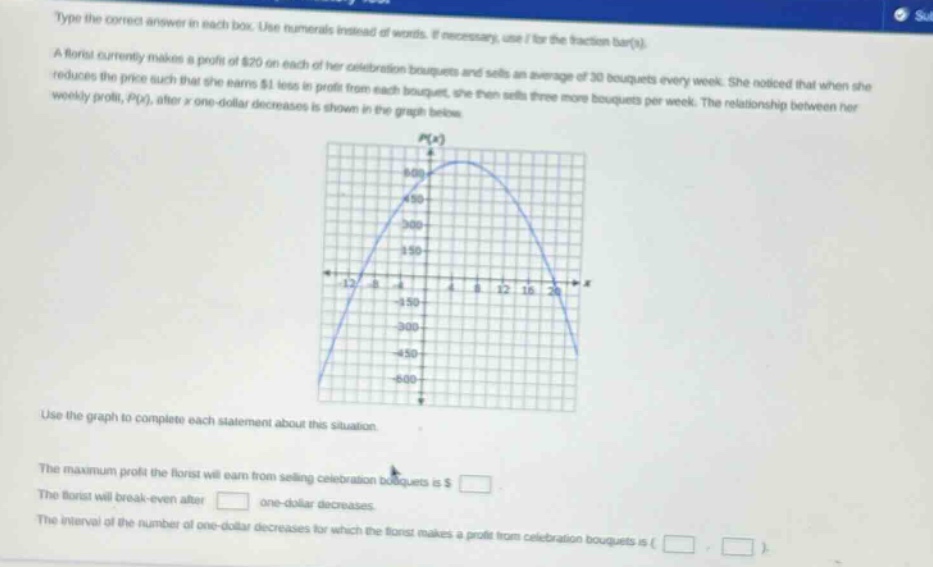
type the correct answer in each box. use numerals instead of words. if necessary, use / for the fraction bar(s). a florist currently makes a profit of $20 on each of her celebration bouquets and sells an average of 30 bouquets every week. she noticed that when she reduces the price such that she earns $1 less in profit from each bouquet, she then sells three more bouquets per week. the relationship between her weekly profit, $p(x)$, after $x$ one - dollar decreases is shown in the graph below. use the graph to complete each statement about this situation. the maximum profit the florist will earn from selling celebration bouquets is $\\square$. the florist will break - even after $\\square$ one - dollar decreases. the interval of the number of one - dollar decreases for which the florist makes a profit from celebration bouquets is $(\\square,\\square)$.
Answer
Answer:
- The maximum profit the florist will earn from selling celebration bouquets is $$480$.
- The florist will break - even after $16$ one - dollar decreases.
- The interval of the number of one - dollar decreases for which the florist makes a profit from celebration bouquets is $(0,16)$.
Explanation:
Step1: Find maximum profit
The maximum point on the profit - function graph $P(x)$ gives the maximum profit. The $y$ - value of the vertex of the parabola is $480$.
Step2: Find break - even point
The break - even point occurs when $P(x)=0$. The graph intersects the $x$ - axis at $x = 0$ and $x = 16$. So after $16$ one - dollar decreases, the florist breaks even.
Step3: Find profit interval
The florist makes a profit when $P(x)>0$. From the graph, this occurs when $0<x<16$.