view policies\ncurrent attempt in progress\nthe standard number of hours that should have been worked for…
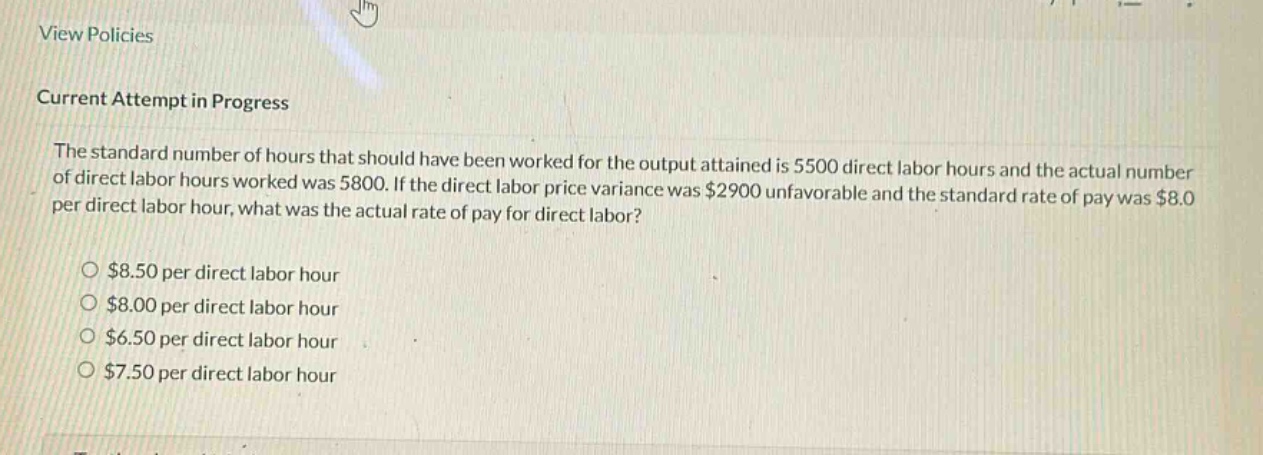
view policies\ncurrent attempt in progress\nthe standard number of hours that should have been worked for the output attained is 5500 direct labor hours and the actual number of direct labor hours worked was 5800. if the direct labor price variance was $2900 unfavorable and the standard rate of pay was $8.0 per direct labor hour, what was the actual rate of pay for direct labor?\n$8.50 per direct labor hour\n$8.00 per direct labor hour\n$6.50 per direct labor hour\n$7.50 per direct labor hour
Answer
Explanation:
Step1: Recall direct - labor price variance formula
Direct - labor price variance = (Actual rate - Standard rate)×Actual hours
We know that the direct - labor price variance is $2900 unfavorable (so positive in value since unfavorable variances are positive in this context), the actual hours ($AH$) = 5800, and the standard rate ($SR$) = $8.0. Let the actual rate be $AR$.
The formula becomes $2900=(AR - 8)\times5800$.
Step2: Solve for the actual rate
First, divide both sides of the equation by 5800: $\frac{2900}{5800}=AR - 8$
$0.5=AR - 8$
Then, add 8 to both sides of the equation: $AR=8 + 0.5$
$AR = 8.5$
Answer:
A. $8.50 per direct labor hour