you have a gross income of $117,151 and are filing your tax return singly. you claim one exemption and can…
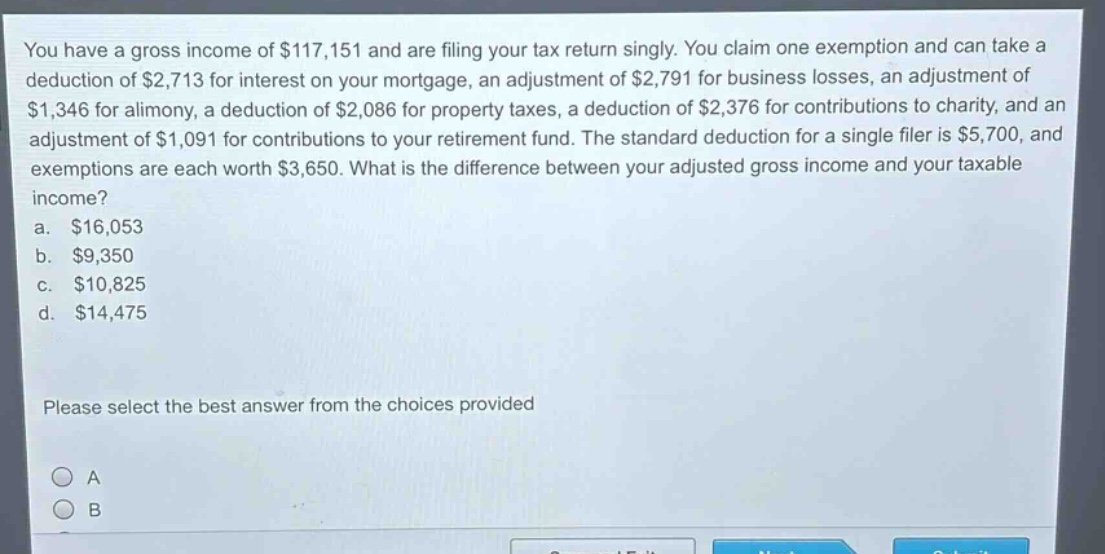
you have a gross income of $117,151 and are filing your tax return singly. you claim one exemption and can take a deduction of $2,713 for interest on your mortgage, an adjustment of $2,791 for business losses, an adjustment of $1,346 for alimony, a deduction of $2,086 for property taxes, a deduction of $2,376 for contributions to charity, and an adjustment of $1,091 for contributions to your retirement fund. the standard deduction for a single filer is $5,700, and exemptions are each worth $3,650. what is the difference between your adjusted gross income and your taxable income?\na. $16,053\nb. $9,350\nc. $10,825\nd. $14,475\nplease select the best answer from the choices provided
Answer
Explanation:
Step1: Calculate adjusted gross income
Adjusted gross income (AGI) is calculated by subtracting adjustments from gross income. Adjustments = $2,791+ 1,346+1,091 = $5,228 AGI = $117,151 - 5,228=$111,923
Step2: Calculate taxable income
Tax - able income is calculated by subtracting the greater of the standard deduction or itemized deductions and exemptions from the AGI. Itemized deductions = $2,713+2,086 + 2,376=$7,175 Since $7,175>5,700$ (standard deduction), we use itemized deductions. Exemption = $3,650 Taxable income = $111,923-(7,175 + 3,650)=$101,098
Step3: Calculate the difference
Difference = AGI - Taxable income Difference = $111,923-101,098 = $10,825
Answer:
C. $10,825