you are the operations manager for an airline and you are considering a higher fare level for passengers in…
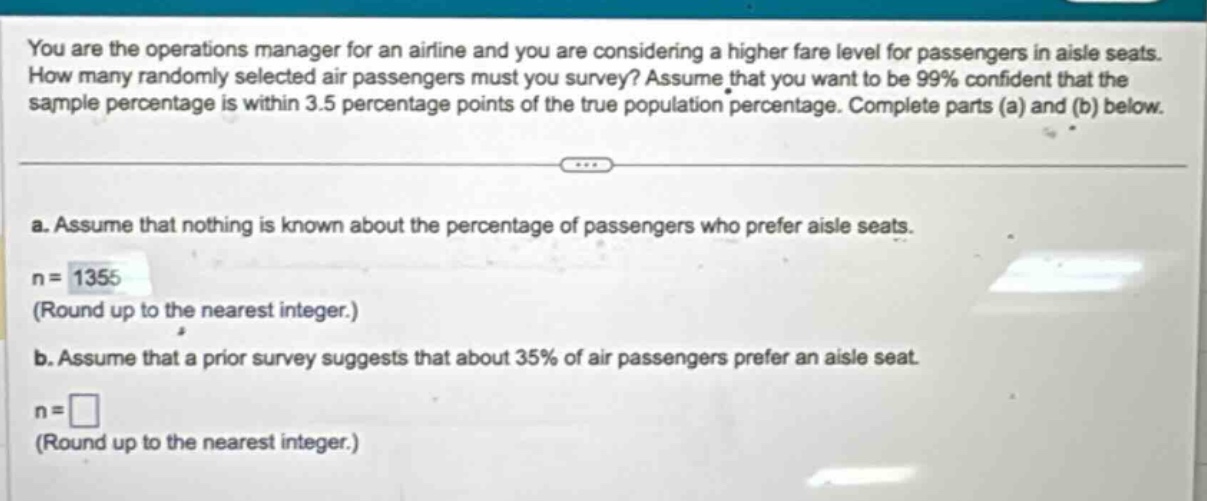
you are the operations manager for an airline and you are considering a higher fare level for passengers in aisle seats. how many randomly selected air passengers must you survey? assume that you want to be 99% confident that the sample percentage is within 3.5 percentage points of the true population percentage. complete parts (a) and (b) below. a. assume that nothing is known about the percentage of passengers who prefer aisle seats. n = 1355 (round up to the nearest integer.) b. assume that a prior survey suggests that about 35% of air passengers prefer an aisle seat. n = (round up to the nearest integer.)
Answer
Explanation:
Step1: Identify the formula for sample - size calculation
The formula for sample size $n$ when estimating a proportion is $n=\frac{z^{2}\cdot p(1 - p)}{E^{2}}$, where $z$ is the z - score corresponding to the confidence level, $p$ is the estimated proportion, and $E$ is the margin of error. For a 99% confidence level, the z - score $z = 2.576$ (from standard normal distribution tables), and the margin of error $E=0.035$.
Step2: Calculate the sample size when $p = 0.35$
Substitute $z = 2.576$, $p = 0.35$, and $E=0.035$ into the formula. First, calculate $p(1 - p)=0.35\times(1 - 0.35)=0.35\times0.65 = 0.2275$. Then, calculate $z^{2}=(2.576)^{2}=6.635776$. Now, $n=\frac{z^{2}\cdot p(1 - p)}{E^{2}}=\frac{6.635776\times0.2275}{(0.035)^{2}}$. $n=\frac{6.635776\times0.2275}{0.001225}=\frac{1.519639}{0.001225}\approx1240.52$.
Step3: Round up the sample size
Since the sample size $n$ must be an integer, we round up to the nearest integer.
Answer:
1241