14. the table below is a representation of values for the function f(x)=e^(x - 3)+2. x -6 -1 0 1 4 7 f(x)…
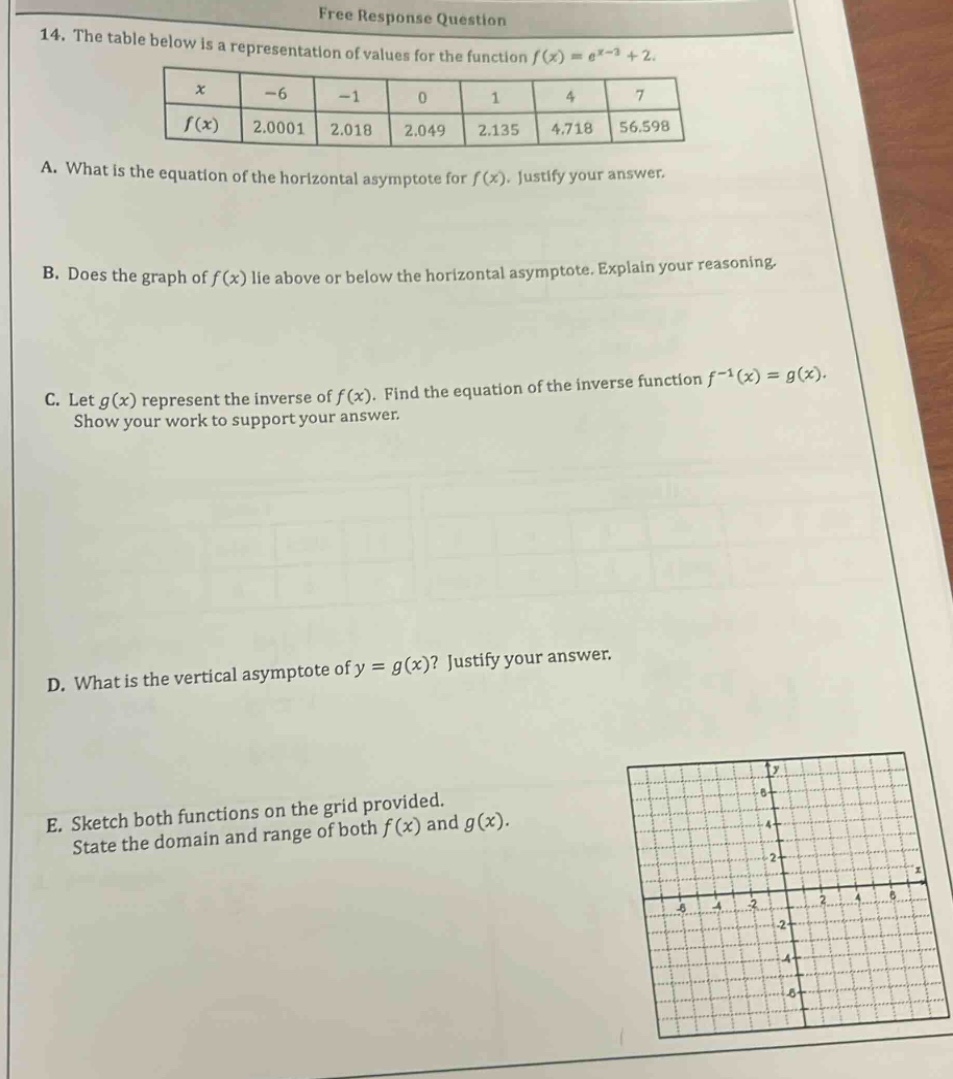
14. the table below is a representation of values for the function f(x)=e^(x - 3)+2. x -6 -1 0 1 4 7 f(x) 2.0001 2.018 2.049 2.135 4.718 56.598 a. what is the equation of the horizontal asymptote for f(x). justify your answer. b. does the graph of f(x) lie above or below the horizontal asymptote. explain your reasoning. c. let g(x) represent the inverse of f(x). find the equation of the inverse function f^(-1)(x)=g(x). show your work to support your answer. d. what is the vertical asymptote of y = g(x)? justify your answer. e. sketch both functions on the grid provided. state the domain and range of both f(x) and g(x).
Answer
Answer:
A.
The equation of the horizontal - asymptote is $y = 2$.
B.
The graph of $f(x)$ lies above the horizontal asymptote.
C.
$y = f(x)=e^{x - 3}+2$. Swap $x$ and $y$: $x = e^{y - 3}+2$. Then $x - 2=e^{y - 3}$. Take the natural logarithm of both sides: $\ln(x - 2)=y - 3$. So $y=\ln(x - 2)+3$, and $f^{-1}(x)=\ln(x - 2)+3$.
D.
The vertical asymptote of $y = g(x)$ is $x = 2$.
E.
For $f(x)=e^{x - 3}+2$:
- Domain: $(-\infty,\infty)$
- Range: $(2,\infty)$ For $g(x)=\ln(x - 2)+3$:
- Domain: $(2,\infty)$
- Range: $(-\infty,\infty)$
Explanation:
A.
As $x\to-\infty$, $e^{x - 3}\to0$. So $y = e^{x - 3}+2\to2$.
B.
Since $e^{x - 3}>0$ for all real $x$, then $f(x)=e^{x - 3}+2>2$.
C.
Step1: Swap variables
$x = e^{y - 3}+2$
Step2: Isolate the exponential term
$x - 2=e^{y - 3}$
Step3: Take natural - log
$\ln(x - 2)=y - 3$
Step4: Solve for $y$
$y=\ln(x - 2)+3$
D.
The domain of $y=\ln u$ is $u>0$. For $y = \ln(x - 2)+3$, $x-2>0$. As $x\to2^{+}$, $\ln(x - 2)\to-\infty$. So $x = 2$ is the vertical asymptote.
E.
For $f(x)$:
The exponential function $e^{x - 3}$ is defined for all real $x$, so the domain is $(-\infty,\infty)$. Since $e^{x - 3}>0$, $f(x)=e^{x - 3}+2>2$, so the range is $(2,\infty)$.
For $g(x)$:
The argument of the natural - logarithm $x - 2>0$, so the domain is $(2,\infty)$. The natural - logarithm function $\ln(x - 2)$ can take on all real values, so the range is $(-\infty,\infty)$.