20. what are volcanic arcs typically associated with? - a. divergent boundaries - b. transform boundaries…
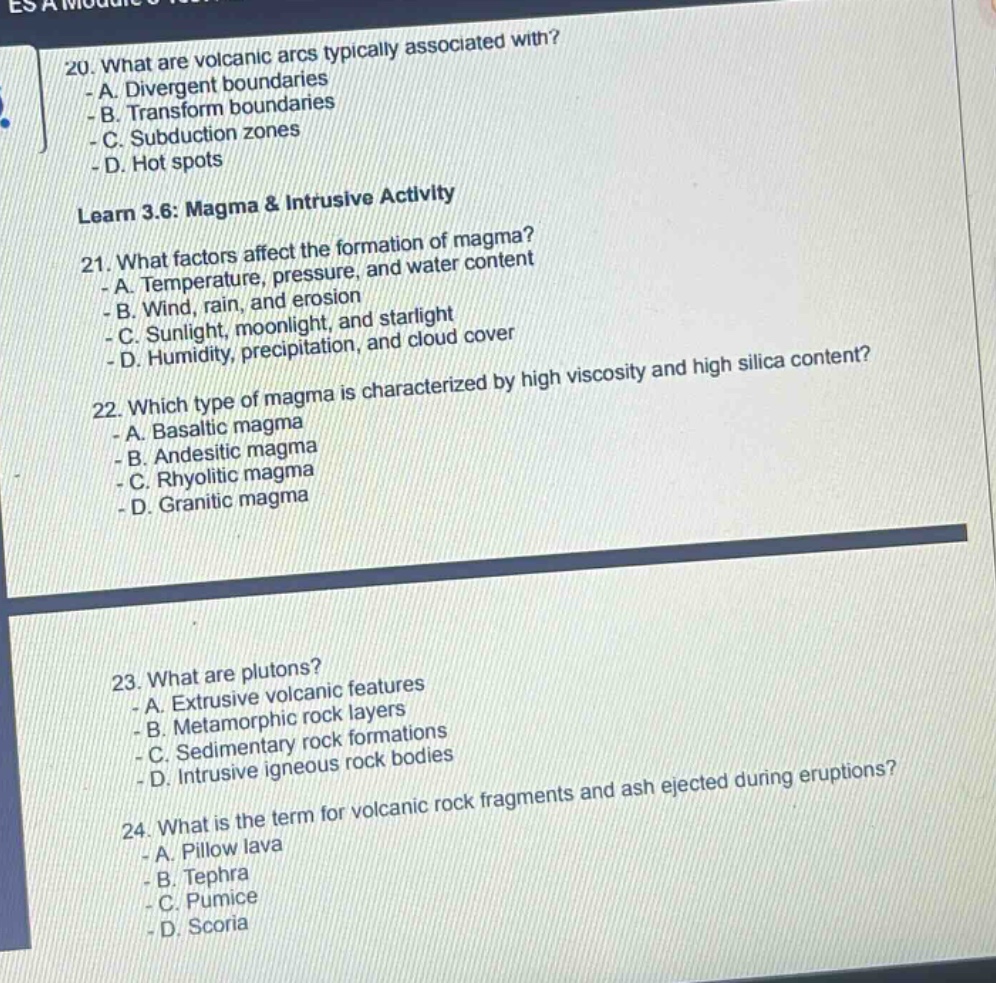
20. what are volcanic arcs typically associated with? - a. divergent boundaries - b. transform boundaries - c. subduction zones - d. hot spots\nlearn 3.6: magma & intrusive activity\n21. what factors affect the formation of magma? - a. temperature, pressure, and water content - b. wind, rain, and erosion - c. sunlight, moonlight, and starlight - d. humidity, precipitation, and cloud cover\n22. which type of magma is characterized by high viscosity and high silica content? - a. basaltic magma - b. andesitic magma - c. rhyolitic magma - d. granitic magma\n23. what are plutons? - a. extrusive volcanic features - b. metamorphic rock layers - c. sedimentary rock formations - d. intrusive igneous rock bodies\n24. what is the term for volcanic rock fragments and ash ejected during eruptions? - a. pillow lava - b. tephra - c. pumice - d. scoria
Answer
Answer:
- C. Subduction zones
- A. Temperature, pressure, and water content
- C. Rhyolitic magma
- D. Intrusive igneous rock bodies
- B. Tephra
Brief Explanations:
- Volcanic arcs form at subduction zones where one tectonic plate is forced beneath another.
- Temperature, pressure, and water content are key factors in magma - formation.
- Rhyolitic magma has high viscosity and high silica content.
- Plutons are large intrusive igneous rock bodies.
- Tephra is the general term for volcanic rock fragments and ash ejected during eruptions.