39. an organization wants to improve its overall effectiveness through behavioral - science knowledge and…
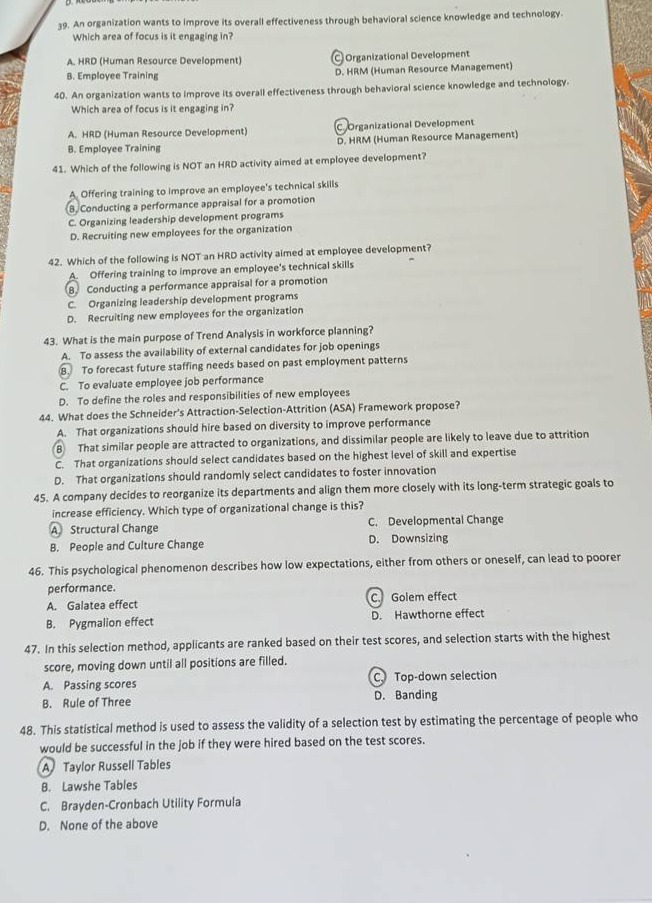
39. an organization wants to improve its overall effectiveness through behavioral - science knowledge and technology.\nwhich area of focus is it engaging in?\na. hrd (human resource development)\nb. employee training\nc. organizational development\nd. hrm (human resource management)\n40. an organization wants to improve its overall effectiveness through behavioral - science knowledge and technology.\nwhich area of focus is it engaging in?\na. hrd (human resource development)\nb. employee training\nc. organizational development\nd. hrm (human resource management)\n41. which of the following is not an hrd activity aimed at employee development?\na. offering training to improve an employees technical skills\nb. conducting a performance appraisal for a promotion\nc. organizing leadership development programs\nd. recruiting new employees for the organization\n42. which of the following is not an hrd activity aimed at employee development?\na. offering training to improve an employees technical skills\nb. conducting a performance appraisal for a promotion\nc. organizing leadership development programs\nd. recruiting new employees for the organization\n43. what is the main purpose of trend analysis in workforce planning?\na. to assess the availability of external candidates for job openings\nb. to forecast future staffing needs based on past employment patterns\nc. to evaluate employee job performance\nd. to define the roles and responsibilities of new - employees\n44. what does the schneiders attraction - selection - attrition (asa) framework propose?\na. that organizations should hire based on diversity to improve performance\nb. that similar people are attracted to organizations, and dissimilar people are likely to leave due to attrition\nc. that organizations should select candidates based on the highest level of skill and expertise\nd. that organizations should randomly select candidates to foster innovation\n45. a company decides to reorganize its departments and align them more closely with its long - term strategic goals to increase efficiency. which type of organizational change is this?\na. structural change\nb. people and culture change\nc. developmental change\nd. downsizing\n46. this psychological phenomenon describes how low expectations, either from others or oneself, can lead to poorer performance.\na. galatea effect\nb. pygmalion effect\nc. golem effect\nd. hawthorne effect\n47. in this selection method, applicants are ranked based on their test scores, and selection starts with the highest score, passing down until all positions are filled.\na. passing scores\nb. rule of three\nc. top - down selection\nd. banding\n48. this statistical method is used to assess the validity of a selection device by estimating the percentage of people who would be successful in the job if they were hired based on the test scores.\na. taylor russell tables\nb. lawshe tables\nc. brayden - cronbach utility formula\nd. none of the above
Answer
Brief Explanations:
39 - 40: Organizational Development focuses on improving overall organizational effectiveness using behavioral - science knowledge. 41 - 42: Recruiting new employees is more about workforce addition rather than employee development in HRD. 43: Trend analysis in workforce planning forecasts future staffing needs based on past patterns. 44: The ASA Framework posits that similar people are attracted to organizations. 45: Reorganizing departments is structural change. 46: The Golem effect describes poor performance due to low expectations. 47: Ranking applicants based on test scores and starting with the highest is top - down selection. 48: Taylor Russell Tables estimate the percentage of successful hires based on test scores.
Answer:
- C. Organizational Development
- C. Organizational Development
- D. Recruiting new employees for the organization
- D. Recruiting new employees for the organization
- B. To forecast future staffing needs based on past employment patterns
- B. That similar people are attracted to organizations
- A. Structural Change
- C. Golem effect
- C. Top - down selection
- A. Taylor Russell Tables