99. why are subduction zones not commonly found at convergent continental - continental boundaries?\n a. the…
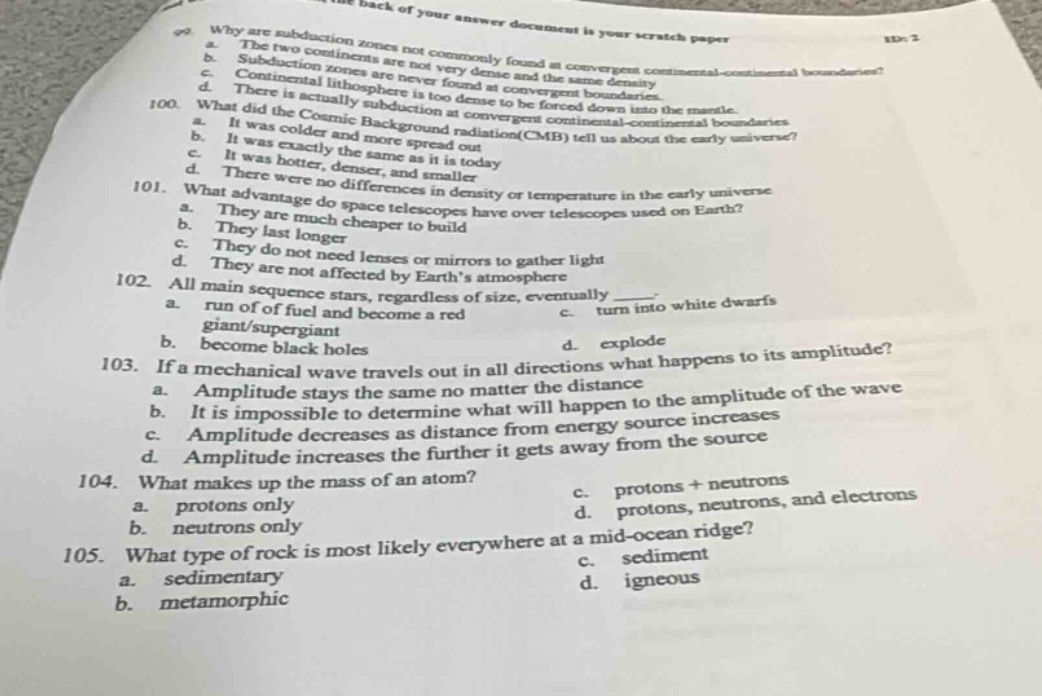
99. why are subduction zones not commonly found at convergent continental - continental boundaries?\n a. the two continents are not very dense and the same density.\n b. subduction zones are never found at convergent boundaries.\n c. continental lithosphere is too dense to be forced down into the mantle.\n d. continental lithosphere is too buoyant to be forced down into the mantle.\n100. what did the cosmic background radiation(cmb) tell us about the early universe?\n a. it was colder and more spread out as it is today.\n b. it was exactly the same as it is today.\n c. it was hotter, denser, and smaller.\n d. there were no differences in density or temperature in the early universe.\n101. what advantage do space telescopes have over telescopes used on earth?\n a. they are much cheaper to build.\n b. they last longer.\n c. they do not need lenses or mirrors to gather light.\n d. they are not affected by earths atmosphere.\n102. all main - sequence stars, regardless of size, eventually \n a. run out of fuel and become a red giant/supergiant\n b. become black holes\n c. turn into white dwarfs\n d. explode\n103. if a mechanical wave travels out in all directions what happens to its amplitude?\n a. amplitude stays the same no matter the distance.\n b. it is impossible to determine what will happen to the amplitude of the wave.\n c. amplitude decreases as distance from energy source increases.\n d. amplitude increases the further it gets away from the source.\n104. what makes up the mass of an atom?\n a. protons only\n b. neutrons only\n c. protons + neutrons\n d. protons, neutrons, and electrons\n105. what type of rock is most likely everywhere at a mid - ocean ridge?\n a. sedimentary\n b. metamorphic\n c. sediment\n d. igneous
Answer
Brief Explanations:
- Subduction zones occur at convergent boundaries where one tectonic plate is forced under another. Continental - continental boundaries have rocks of similar density, so subduction is less common as neither plate is easily subducted.
- The Cosmic Microwave Background (CMB) indicates the early universe was hotter, denser, and smaller.
- Space telescopes are not affected by Earth's atmosphere which can distort and absorb light, giving them an advantage over Earth - based telescopes.
- All main - sequence stars, regardless of size, eventually run out of fuel and become red giants/supergiants first, and then depending on mass, may become white dwarfs, black holes, or explode.
- As a mechanical wave travels out in all directions from a source, its amplitude decreases as the energy is spread over a larger area.
- The mass of an atom is mainly made up of protons and neutrons in the nucleus as electrons have negligible mass compared to them.
- Mid - ocean ridges are areas of seafloor spreading where new oceanic crust is formed. Igneous rock is most likely to be found there as magma rises and solidifies.
Answer:
- a. The two continents are not commonly found at convergent continental - continental boundaries.
- c. It was hotter, denser, and smaller.
- d. They are not affected by Earth's atmosphere.
- a. run out of fuel and become a red giant/supergiant
- c. Amplitude decreases as the distance from energy source increases
- c. protons + neutrons
- d. igneous