answer: f(2)=0 and f(2)=-14 so f has a local maximum at x = 2. #____ - find the radius of convergence of the…
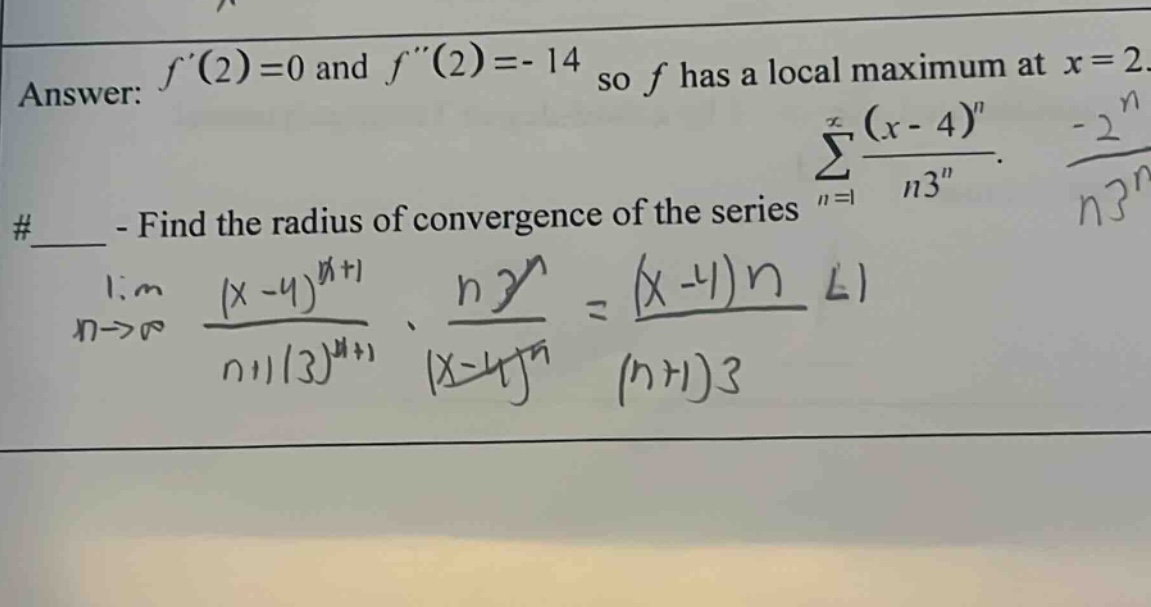
answer: f(2)=0 and f(2)=-14 so f has a local maximum at x = 2. #____ - find the radius of convergence of the series ∑(n = 1 to ∞) (x - 4)^n / (n3^n). lim(n→∞) ((x - 4)^(n + 1) / ((n + 1)3^(n + 1))) * (n3^n / (x - 4)^n) = ((x - 4)n / ((n + 1)3)) < 1
Answer
Explanation:
Step1: Apply ratio - test formula
Let $a_n=\frac{(x - 4)^n}{n3^n}$. Then $a_{n + 1}=\frac{(x - 4)^{n+1}}{(n + 1)3^{n+1}}$. Calculate $\lim_{n\rightarrow\infty}\left|\frac{a_{n+1}}{a_n}\right|=\lim_{n\rightarrow\infty}\left|\frac{\frac{(x - 4)^{n+1}}{(n + 1)3^{n+1}}}{\frac{(x - 4)^n}{n3^n}}\right|$.
Step2: Simplify the ratio
$\lim_{n\rightarrow\infty}\left|\frac{(x - 4)^{n+1}}{(n + 1)3^{n+1}}\cdot\frac{n3^n}{(x - 4)^n}\right|=\lim_{n\rightarrow\infty}\left|\frac{(x - 4)n}{(n + 1)3}\right|=\left|\frac{x - 4}{3}\right|\lim_{n\rightarrow\infty}\frac{n}{n + 1}$.
Step3: Evaluate the limit of $\frac{n}{n + 1}$
Since $\lim_{n\rightarrow\infty}\frac{n}{n + 1}=\lim_{n\rightarrow\infty}\frac{1}{1+\frac{1}{n}} = 1$, the ratio - test gives $\left|\frac{x - 4}{3}\right|\lt1$.
Step4: Solve for the radius of convergence
From $\left|\frac{x - 4}{3}\right|\lt1$, we can rewrite it as $|x - 4|\lt3$. By the definition of the radius of convergence $R$ for a power series $\sum a_n(x - c)^n$ (here $c = 4$), the radius of convergence $R$ is the value such that $|x - c|\lt R$. So $R = 3$.
Answer:
$3$