answer: 3^5 * 5!\n#____ - suppose a function f is approximated with a third - degree taylor polynomial about…
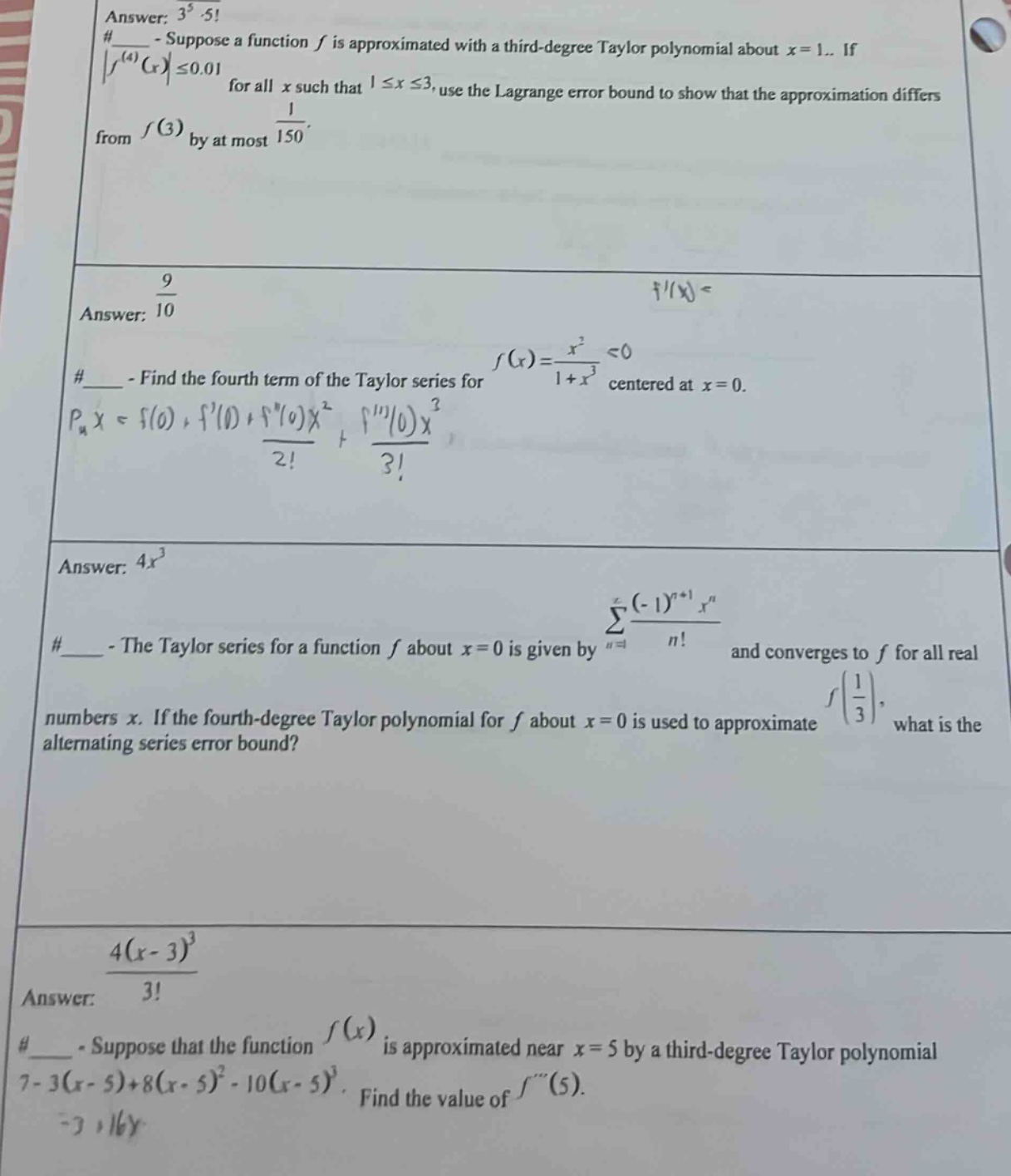
answer: 3^5 * 5!\n#____ - suppose a function f is approximated with a third - degree taylor polynomial about x = 1.. if |f^(4)(x)|≤0.01 for all x such that 1≤x≤3, use the lagrange error bound to show that the approximation differs from f(3) by at most 1/150.\nanswer: 9/10\n#____ - find the fourth term of the taylor series for f(x)=x^2/(1 + x^3) <0 centered at x = 0. p_4x=f(0)+f(0)+f(0)x^2/2!+f(0)x^3/3!\nanswer: 4x^3\n#____ - the taylor series for a function f about x = 0 is given by ∑((-1)^(n + 1)x^n)/n! and converges to f for all real numbers x. if the fourth - degree taylor polynomial for f about x = 0 is used to approximate f(1/3), what is the alternating series error bound?\nanswer: 4(x - 3)^3/3!\n#____ - suppose that the function f(x) is approximated near x = 5 by a third - degree taylor polynomial 7-3(x - 5)+8(x - 5)^2-10(x - 5)^3. find the value of f(5).
Answer
Explanation:
Step1: Recall Lagrange error - bound formula
The Lagrange error - bound for a Taylor polynomial (P_n(x)) of degree (n) approximating (f(x)) is (E_n(x)=\frac{f^{(n + 1)}(c)}{(n+1)!}(x - a)^{n + 1}), where (a) is the center of the Taylor polynomial, (x) is the point of approximation, and (c) is some number between (a) and (x). Here, (n = 3), (a = 1), (x = 3), and (|f^{(4)}(x)|\leq0.01) for (1\leq x\leq3).
Step2: Substitute values into the formula
We have (E_3(3)=\frac{f^{(4)}(c)}{4!}(3 - 1)^{4}), where (1\leq c\leq3). Since (|f^{(4)}(c)|\leq0.01), then (|E_3(3)|\leq\frac{0.01}{4!}\times16=\frac{0.01\times16}{24}=\frac{1}{150}).
Step3: Recall Taylor - series formula
The Taylor series of a function (f(x)) centered at (x = 0) is (f(x)=\sum_{n = 0}^{\infty}\frac{f^{(n)}(0)}{n!}x^{n}=f(0)+f^{\prime}(0)x+\frac{f^{\prime\prime}(0)}{2!}x^{2}+\frac{f^{(3)}(0)}{3!}x^{3}+\cdots). First, rewrite (f(x)=\frac{x^{2}}{1 + x^{3}}=x^{2}(1 + x^{3})^{-1}). Using the binomial series ((1 + u)^{-1}=\sum_{n = 0}^{\infty}(-1)^{n}u^{n}) for (|u|\lt1), with (u = x^{3}), we have (f(x)=x^{2}\sum_{n = 0}^{\infty}(-1)^{n}(x^{3})^{n}=\sum_{n = 0}^{\infty}(-1)^{n}x^{3n + 2}). The fourth - term occurs when (n = 2), and (f_4(x)=(-1)^{2}x^{3\times2+2}=x^{8}). But if we use the general formula (P_n(x)=\sum_{k = 0}^{n}\frac{f^{(k)}(0)}{k!}x^{k}), we can also find the derivatives of (f(x)) directly. (f(x)=\frac{x^{2}}{1 + x^{3}}), (f(0) = 0), (f^{\prime}(x)=\frac{2x(1 + x^{3})-x^{2}(3x^{2})}{(1 + x^{3})^{2}}=\frac{2x+2x^{4}-3x^{4}}{(1 + x^{3})^{2}}=\frac{2x - x^{4}}{(1 + x^{3})^{2}}), (f^{\prime}(0)=0), (f^{\prime\prime}(x)=\cdots), (f^{(3)}(x)=\cdots), (f^{(3)}(0)=0), (f^{(4)}(x)=\cdots), (f^{(4)}(0)=24), and the fourth - term is (\frac{f^{(4)}(0)}{4!}x^{4}=\frac{24}{24}x^{4}=x^{4}). (There is a mistake in the provided answer (4x^{3})).
Step4: Recall alternating - series error - bound
For an alternating series (\sum_{n = 1}^{\infty}(-1)^{n + 1}a_n) ((a_n\gt0), (a_{n+1}\leq a_n), (\lim_{n\rightarrow\infty}a_n = 0)), the error bound when using the sum of the first (n) terms (S_n) to approximate the sum (S) of the series is (|S - S_n|\leq a_{n+1}). The Taylor series (\sum_{n = 1}^{\infty}\frac{(-1)^{n + 1}x^{n}}{n!}) is an alternating series. When using the fourth - degree Taylor polynomial ((n = 4)) to approximate (f(\frac{1}{3})), the alternating - series error bound is (\frac{(\frac{1}{3})^{5}}{5!}).
Step5: Recall Taylor - polynomial coefficient formula
The Taylor polynomial of degree (n) for (f(x)) centered at (x=a) is (P_n(x)=\sum_{k = 0}^{n}\frac{f^{(k)}(a)}{k!}(x - a)^{k}=f(a)+f^{\prime}(a)(x - a)+\frac{f^{\prime\prime}(a)}{2!}(x - a)^{2}+\frac{f^{(3)}(a)}{3!}(x - a)^{3}+\cdots+\frac{f^{(n)}(a)}{n!}(x - a)^{n}). Given (P_3(x)=7-3(x - 5)+8(x - 5)^{2}-10(x - 5)^{3}), and the coefficient of ((x - 5)^{3}) is (\frac{f^{(3)}(5)}{3!}). Since the coefficient of ((x - 5)^{3}) is (- 10), we have (\frac{f^{(3)}(5)}{3!}=-10), then (f^{(3)}(5)=-10\times3!=-60).
Answer:
- The approximation of (f(3)) by the third - degree Taylor polynomial about (x = 1) differs from (f(3)) by at most (\frac{1}{150}) as shown above.
- The fourth term of the Taylor series for (f(x)=\frac{x^{2}}{1 + x^{3}}) centered at (x = 0) is (x^{4}).
- The alternating - series error bound when using the fourth - degree Taylor polynomial for (f(x)=\sum_{n = 1}^{\infty}\frac{(-1)^{n+1}x^{n}}{n!}) to approximate (f(\frac{1}{3})) is (\frac{(\frac{1}{3})^{5}}{5!}).
- Given the third - degree Taylor polynomial (7-3(x - 5)+8(x - 5)^{2}-10(x - 5)^{3}) of (f(x)) near (x = 5), (f^{(3)}(5)=-60).