a boat docked on a pier rises and falls as the tide rises and falls. when the tide is high, the base of the…
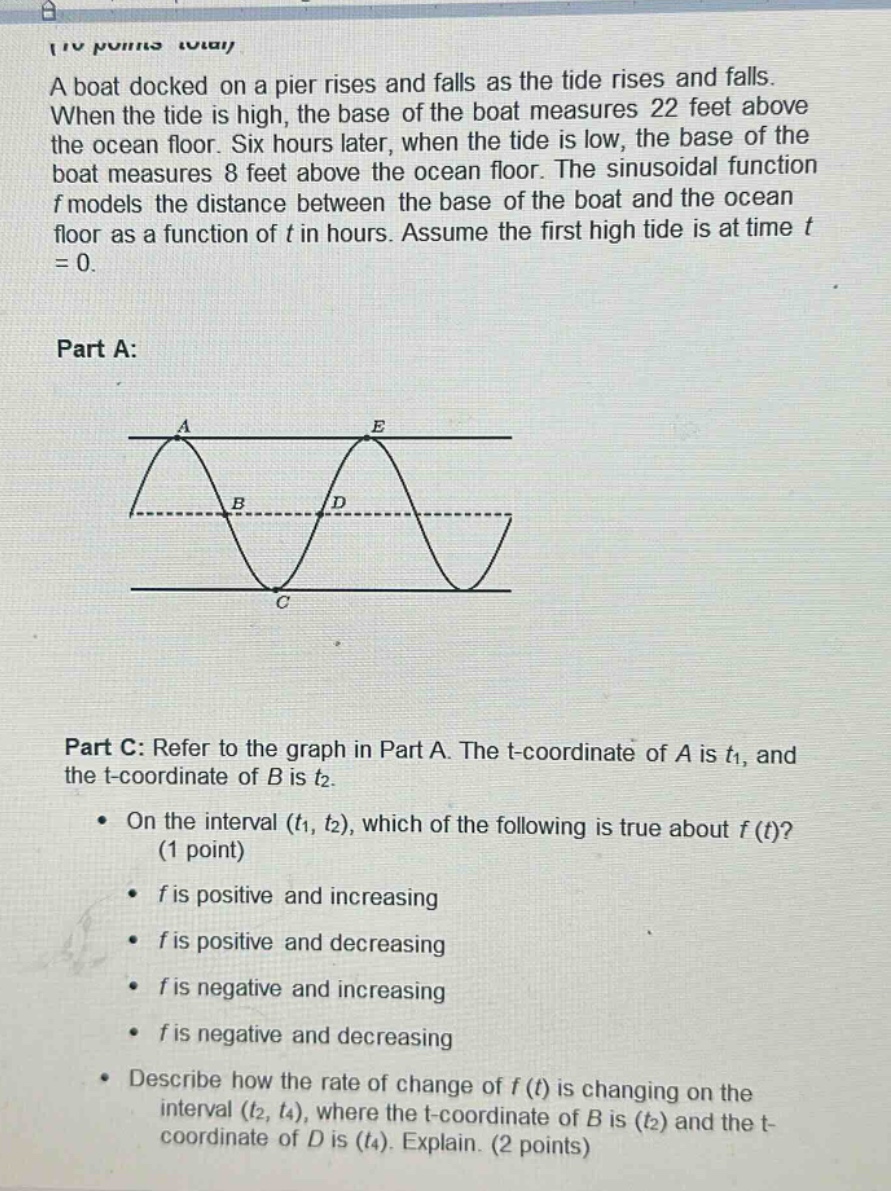
a boat docked on a pier rises and falls as the tide rises and falls. when the tide is high, the base of the boat measures 22 feet above the ocean floor. six hours later, when the tide is low, the base of the boat measures 8 feet above the ocean floor. the sinusoidal function f models the distance between the base of the boat and the ocean floor as a function of t in hours. assume the first high tide is at time t = 0. part a: image of a sinusoidal - like graph with points a, b, c, d, e part c: refer to the graph in part a. the t - coordinate of a is t1, and the t - coordinate of b is t2. on the interval (t1, t2), which of the following is true about f(t)? (1 point) f is positive and increasing f is positive and decreasing f is negative and increasing f is negative and decreasing describe how the rate of change of f(t) is changing on the interval (t2, t4), where the t - coordinate of b is (t2) and the t - coordinate of d is (t4). explain. (2 points)
Answer
Explanation:
Step1: Analyze the function's value on ((t_1,t_2))
The function (f(t)) represents the distance between the base of the boat and the ocean - floor. Distance is non - negative, so (f(t)>0). As we move from (t = t_1) (high - tide) to (t = t_2) (going towards low - tide), the value of (f(t)) is decreasing. So on the interval ((t_1,t_2)), (f) is positive and decreasing.
Step2: Analyze the rate of change on ((t_2,t_4))
The function (f(t)) is a sinusoidal function. The rate of change of a function is given by its derivative. On the interval ((t_2,t_4)), the function (f(t)) is first decreasing at a decreasing rate (the slope of the tangent line is becoming less negative) until it reaches the minimum (at the mid - point of ((t_2,t_4))) and then it starts increasing at an increasing rate (the slope of the tangent line is becoming more positive).
Answer:
- For the first part: (f) is positive and decreasing
- For the second part: The rate of change of (f(t)) is first decreasing (becoming less negative) until the mid - point of ((t_2,t_4)) and then increasing (becoming more positive) because the slope of the tangent line to the sinusoidal function (f(t)) changes in this way as the function moves from a decreasing part of the cycle towards an increasing part.