a calculator is allowed for this question. a golf ball is hit so that it travels a horizontal distance of…
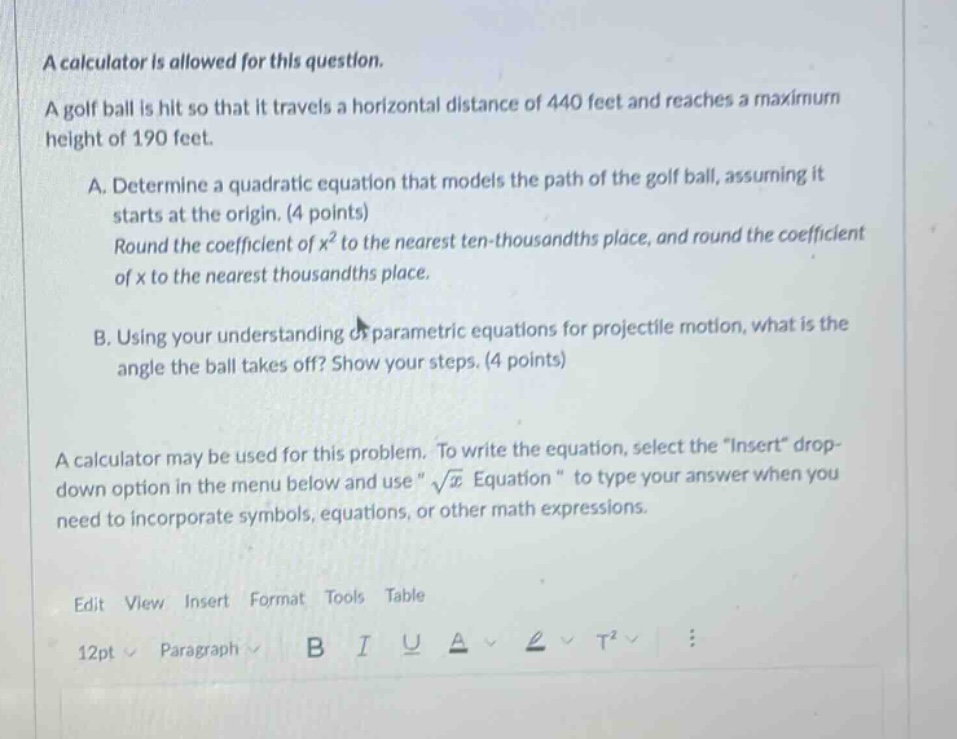
a calculator is allowed for this question. a golf ball is hit so that it travels a horizontal distance of 440 feet and reaches a maximum height of 190 feet. a. determine a quadratic equation that models the path of the golf ball, assuming it starts at the origin. (4 points) round the coefficient of x² to the nearest ten - thousandths place, and round the coefficient of x to the nearest thousandths place. b. using your understanding of parametric equations for projectile motion, what is the angle the ball takes off? show your steps. (4 points) a calculator may be used for this problem. to write the equation, select the “insert” drop - down option in the menu below and use “√x equation “ to type your answer when you need to incorporate symbols, equations, or other math expressions. edit view insert format tools table 12pt paragraph b i u a t²
Answer
Answer:
A.
The quadratic - equation of a parabola with vertex - form (y=a(x - h)^2 + k), where the vertex ((h,k)) is the maximum point of the parabola. The ball starts at the origin ((0,0)) and the maximum point is ((h,k)=(220,190)) (since the maximum occurs at the mid - point of the horizontal range, and the range is (440)).
Substitute ((x,y)=(0,0)) and ((h,k)=(220,190)) into (y=a(x - h)^2 + k):
(0=a(0 - 220)^2+190)
(0 = 48400a+190)
(48400a=-190)
(a=-\frac{190}{48400}\approx - 0.0039)
The equation in vertex - form is (y=-0.0039(x - 220)^2+190)
Expand it: (y=-0.0039(x^{2}-440x + 48400)+190)
(y=-0.0039x^{2}+1.716x-188.76 + 190)
(y=-0.0039x^{2}+1.716x + 1.24)
B.
The parametric equations for projectile motion are (x = v_0\cos\theta t) and (y=v_0\sin\theta t-\frac{1}{2}gt^{2}), where (g = 32\mathrm{ft/s}^2).
At the maximum height, the vertical velocity (v_y = v_0\sin\theta−gt = 0), so (t=\frac{v_0\sin\theta}{g})
The maximum height (y_{max}=v_0\sin\theta\cdot\frac{v_0\sin\theta}{g}-\frac{1}{2}g(\frac{v_0\sin\theta}{g})^{2}=\frac{v_0^{2}\sin^{2}\theta}{2g})
The range (R=\frac{2v_0^{2}\sin\theta\cos\theta}{g})
We know that (y_{max}=190) and (R = 440)
From (y_{max}=\frac{v_0^{2}\sin^{2}\theta}{2g}), we have (v_0^{2}=\frac{2gy_{max}}{\sin^{2}\theta})
Substitute (v_0^{2}) into the range formula (R=\frac{2v_0^{2}\sin\theta\cos\theta}{g}):
(R=\frac{2\cdot\frac{2gy_{max}}{\sin^{2}\theta}\cdot\sin\theta\cos\theta}{g})
(R = 4y_{max}\cot\theta)
(\cot\theta=\frac{R}{4y_{max}})
Substitute (R = 440) and (y_{max}=190)
(\cot\theta=\frac{440}{4\times190}=\frac{440}{760}\approx0.579)
(\theta=\arctan(\frac{1}{\cot\theta}))
(\theta=\arctan(\frac{760}{440})\approx\arctan(1.727)\approx59.9^{\circ}\approx60^{\circ})
Explanation:
A.
Step1: Identify vertex - form
Use (y=a(x - h)^2 + k) with ((h,k)=(220,190))
Step2: Find (a)
Substitute ((0,0)) into (y=a(x - 220)^2+190)
Step3: Expand
Expand (y=-0.0039(x - 220)^2+190)
B.
Step1: Recall parametric equations
Use (x = v_0\cos\theta t) and (y=v_0\sin\theta t-\frac{1}{2}gt^{2})
Step2: Find (t) at max height
Set (v_y = 0) to get (t=\frac{v_0\sin\theta}{g})
Step3: Express (v_0^{2}) from max - height
(v_0^{2}=\frac{2gy_{max}}{\sin^{2}\theta})
Step4: Substitute into range formula
Substitute (v_0^{2}) into (R=\frac{2v_0^{2}\sin\theta\cos\theta}{g})
Step5: Solve for (\theta)
Find (\theta) from (\cot\theta=\frac{R}{4y_{max}})