current attempt in progress let c(n) be a citys cost, in millions of dollars, for plowing the roads when n…
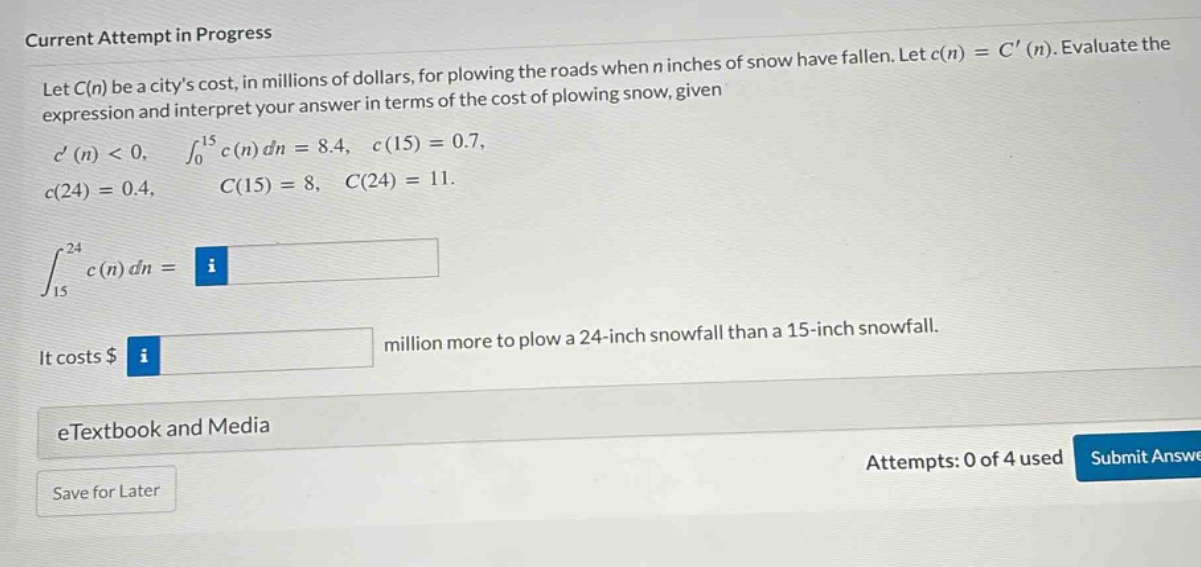
current attempt in progress let c(n) be a citys cost, in millions of dollars, for plowing the roads when n inches of snow have fallen. let c(n)=c(n). evaluate the expression and interpret your answer in terms of the cost of plowing snow, given c(n)<0, ∫₀¹⁵ c(n)dn = 8.4, c(15)=0.7, c(24)=0.4, c(15)=8, c(24)=11. ∫₁₅²⁴ c(n)dn = it costs $ million more to plow a 24 - inch snowfall than a 15 - inch snowfall. etextbook and media save for later attempts: 0 of 4 used submit answe
Answer
Explanation:
Step1: Use fundamental theorem of calculus
By the fundamental theorem of calculus, $\int_{a}^{b}C'(n)dn = C(b)-C(a)$. Since $c(n)=C'(n)$, we have $\int_{15}^{24}c(n)dn=C(24)-C(15)$.
Step2: Substitute given values
We know that $C(15) = 8$ and $C(24)=11$. Substituting these values into the formula $\int_{15}^{24}c(n)dn=C(24)-C(15)$, we get $\int_{15}^{24}c(n)dn=11 - 8$.
Answer:
3 It costs $3$ million more to plow a 24 - inch snowfall than a 15 - inch snowfall.