current attempt in progress let c(n) be a citys cost, in millions of dollars, for plowing the roads when n…
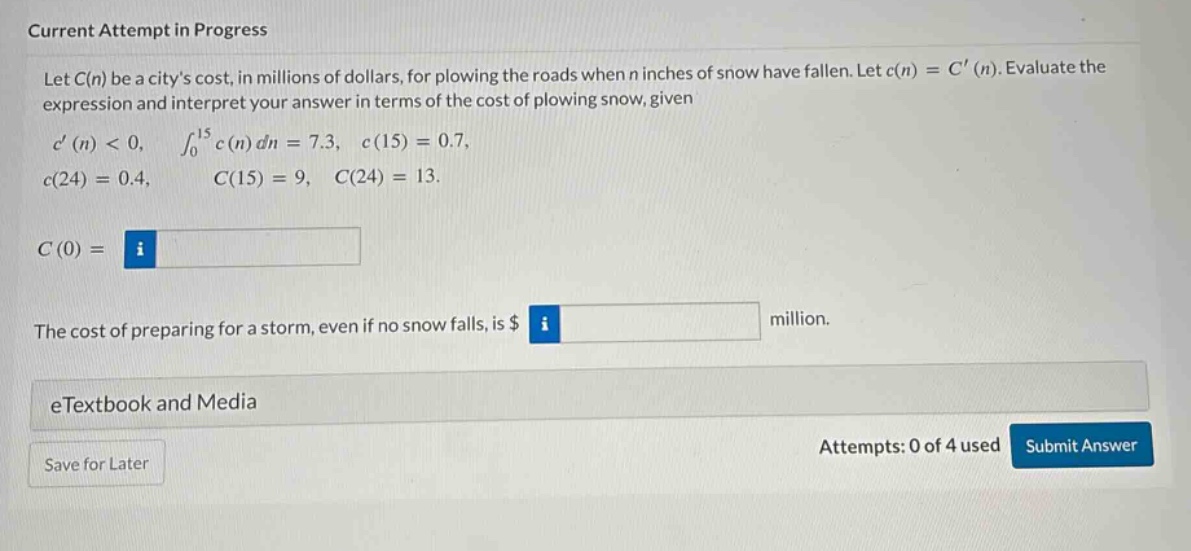
current attempt in progress let c(n) be a citys cost, in millions of dollars, for plowing the roads when n inches of snow have fallen. let c(n)=c(n). evaluate the expression and interpret your answer in terms of the cost of plowing snow, given c(n)<0, ∫₀¹⁵ c(n) dn = 7.3, c(15)=0.7, c(24)=0.4, c(15)=9, c(24)=13. c(0)= the cost of preparing for a storm, even if no snow falls, is $ million. etextbook and media save for later attempts: 0 of 4 used submit answer
Answer
Explanation:
Step1: Recall the fundamental theorem of calculus
We know that $\int_{0}^{15}c(n)dn = C(15)-C(0)$ since $c(n)=C^{\prime}(n)$.
Step2: Rearrange the formula to solve for $C(0)$
From $\int_{0}^{15}c(n)dn = C(15)-C(0)$, we can rewrite it as $C(0)=C(15)-\int_{0}^{15}c(n)dn$.
Step3: Substitute the given values
We are given that $\int_{0}^{15}c(n)dn = 7.3$ and $C(15)=9$. Substituting these values into the formula $C(0)=C(15)-\int_{0}^{15}c(n)dn$, we get $C(0)=9 - 7.3$.
Step4: Calculate the result
$C(0)=1.7$.
Answer:
$1.7$