current attempt in progress let c(n) be a citys cost, in millions of dollars, for plowing the roads when n…
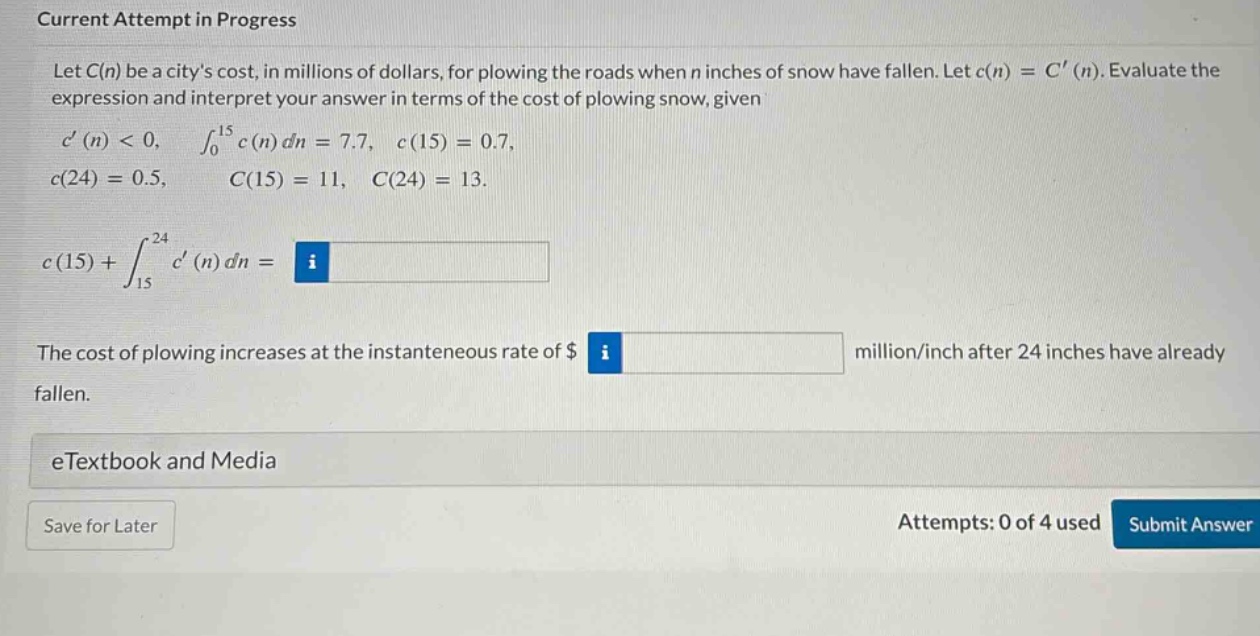
current attempt in progress let c(n) be a citys cost, in millions of dollars, for plowing the roads when n inches of snow have fallen. let c(n)=c(n). evaluate the expression and interpret your answer in terms of the cost of plowing snow, given c(n)<0, ∫₀¹⁵ c(n) dn = 7.7, c(15)=0.7, c(24)=0.5, c(15)=11, c(24)=13. c(15)+∫₁₅²⁴ c(n) dn = the cost of plowing increases at the instantaneous rate of $ million/inch after 24 inches have already fallen. etextbook and media save for later attempts: 0 of 4 used submit answer
Answer
Explanation:
Step1: Apply the fundamental theorem of calculus
By the fundamental theorem of calculus, $\int_{a}^{b}c^{\prime}(n)dn=c(b)-c(a)$. Here $a = 15$ and $b = 24$, so $\int_{15}^{24}c^{\prime}(n)dn=c(24)-c(15)$.
Step2: Substitute the given values
We know that $c(15)=0.7$ and $c(24)=0.5$. Then $c(15)+\int_{15}^{24}c^{\prime}(n)dn=c(15)+c(24)-c(15)$.
Step3: Simplify the expression
$c(15)+c(24)-c(15)=c(24)$. Substituting the value of $c(24) = 0.5$, we get the result.
The second - part of the question asks for $c^{\prime}(24)$. We are given that $c^{\prime}(n)<0$, but no direct information about the value of $c^{\prime}(24)$ is provided in the data to calculate a numerical value.
Answer:
$c(15)+\int_{15}^{24}c^{\prime}(n)dn = 0.5$; No value can be determined for the instantaneous rate after 24 inches from given data.