the derivative is zero at two values of x, both being local maxima. the derivative is zero at two values of…
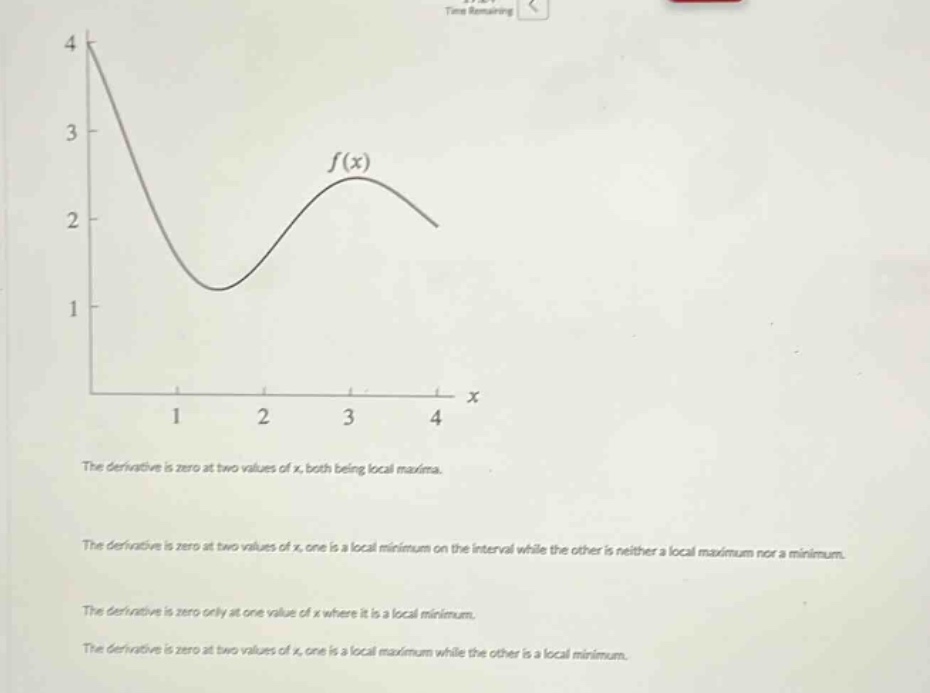
the derivative is zero at two values of x, both being local maxima. the derivative is zero at two values of x, one is a local minimum on the interval while the other is neither a local maximum nor a minimum. the derivative is zero only at one value of x where it is a local minimum. the derivative is zero at two values of x, one is a local maximum while the other is a local minimum.
Answer
Explanation:
Step1: Recall derivative - extrema relationship
The derivative of a function is zero at critical points. A local minimum occurs when the function changes from decreasing (negative - derivative) to increasing (positive - derivative), and a local maximum occurs when the function changes from increasing (positive - derivative) to decreasing (negative - derivative).
Step2: Analyze the graph
From the graph of (y = f(x)), we can see that the function has a local minimum around (x = 1) (the function is decreasing before (x = 1) and increasing after (x = 1)) and a local maximum around (x = 3) (the function is increasing before (x = 3) and decreasing after (x = 3)). The derivative of the function (f(x)) is zero at these two points (critical points).
Answer:
The derivative is zero at two values of (x), one is a local maximum while the other is a local minimum.