if r = {(x, y) | -1 ≤ x ≤ 1, -5 ≤ y ≤ 5}, evaluate the integral ∬_r √(1 - x²) da. solution it would be very…
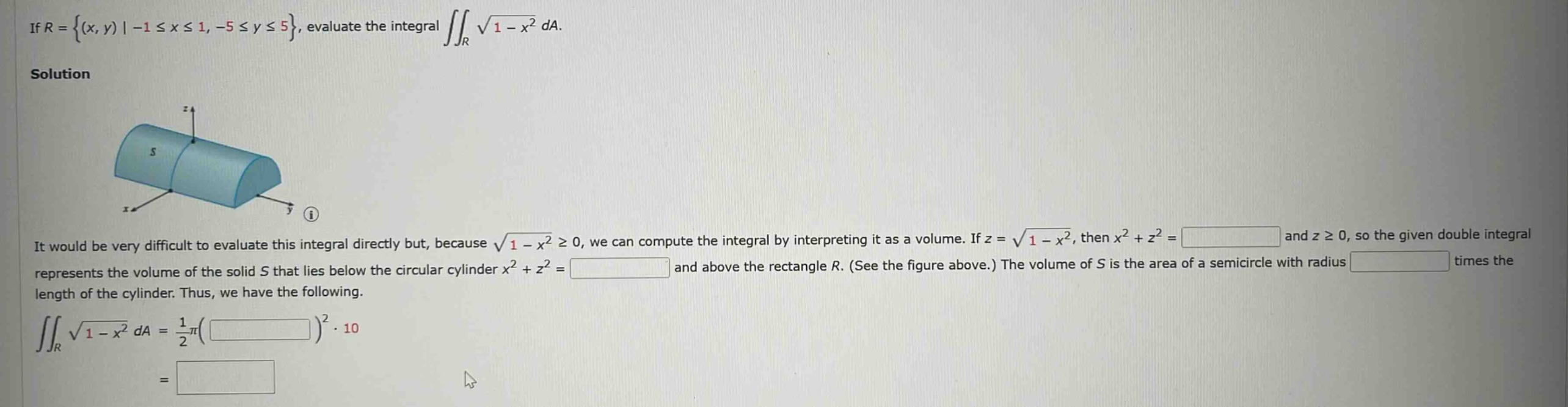
if r = {(x, y) | -1 ≤ x ≤ 1, -5 ≤ y ≤ 5}, evaluate the integral ∬_r √(1 - x²) da. solution it would be very difficult to evaluate this integral directly but, because √(1 - x²) ≥ 0, we can compute the integral by interpreting it as a volume. if z = √(1 - x²), then x² + z² = and z ≥ 0, so the given double integral represents the volume of the solid s that lies below the circular cylinder x² + z² = and above the rectangle r. (see the figure above.) the volume of s is the area of a semi - circle with radius times the length of the cylinder. thus, we have the following. ∬_r √(1 - x²) da = 1/2π( )²·10 =
Answer
Explanation:
Step1: Rewrite the equation
If $z = \sqrt{1 - x^{2}}$, then by squaring both sides, we get $x^{2}+z^{2}=1$ and $z\geq0$.
Step2: Identify the radius
The equation $x^{2}+z^{2}=1$ represents a circle. For a circle of the form $x^{2}+z^{2}=r^{2}$, the radius $r = 1$.
Step3: Calculate the volume
The double - integral $\iint_{R}\sqrt{1 - x^{2}}dA$ represents the volume of a solid. The cross - sectional area of the solid in the $xz$ - plane is a semi - circle with area $A=\frac{1}{2}\pi r^{2}$, and the length of the solid in the $y$ - direction is $L = 5-(-5)=10$. Substituting $r = 1$ into the volume formula $V=A\times L$, we have $V=\frac{1}{2}\pi(1)^{2}\times10$.
Step4: Simplify the result
$\frac{1}{2}\pi(1)^{2}\times10 = 5\pi$.
Answer:
$5\pi$