fill in the blanks. if the value does not exist, type dne in the blank. lim x→3− f(x)= lim x→3+ f(x)= lim…
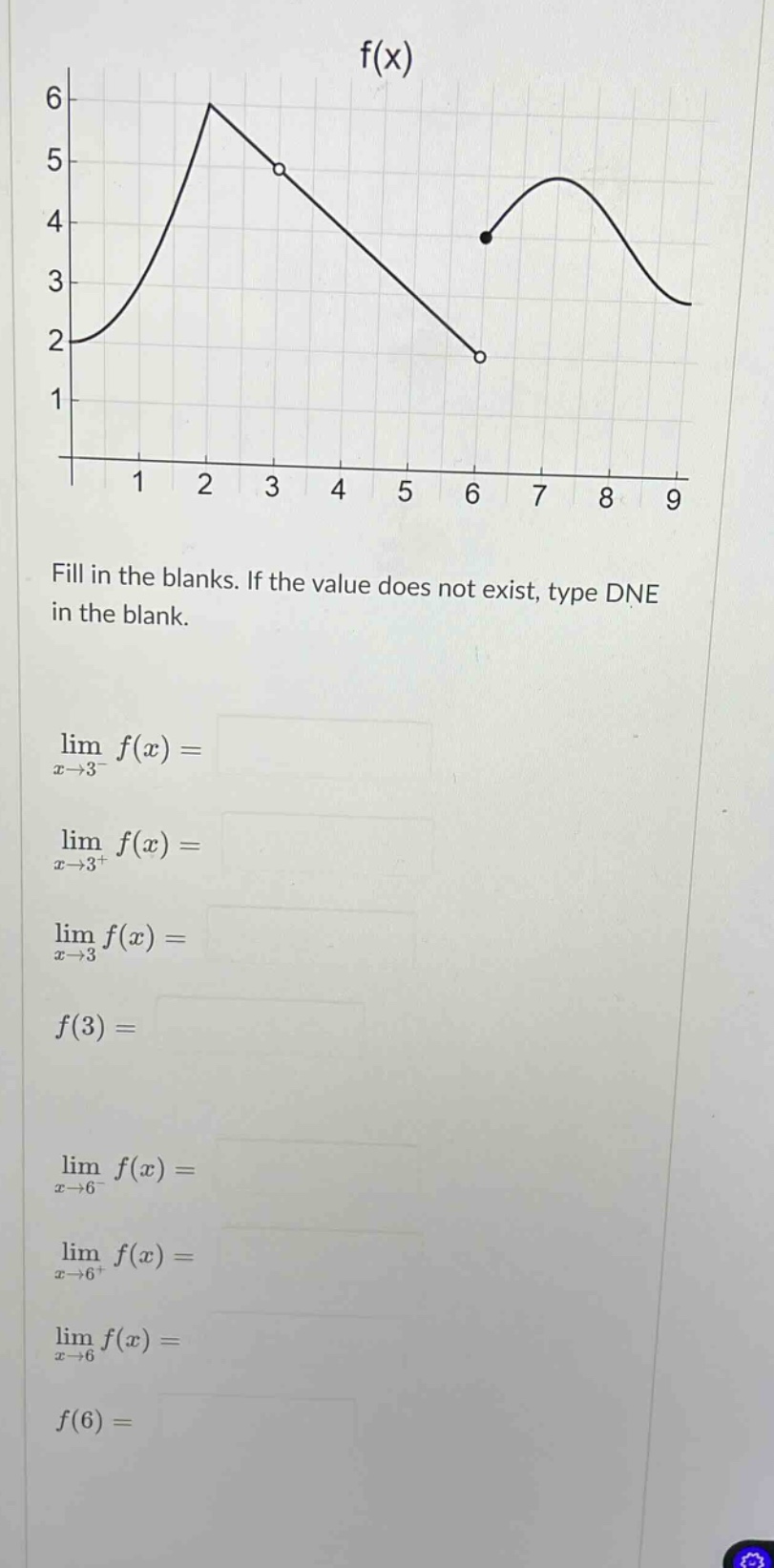
fill in the blanks. if the value does not exist, type dne in the blank. lim x→3− f(x)= lim x→3+ f(x)= lim x→3 f(x)= f(3)= lim x→6− f(x)= lim x→6+ f(x)= lim x→6 f(x)= f(6)=
Answer
Explanation:
Step1: Find left - hand limit as $x\to3^{-}$
As $x$ approaches 3 from the left side, we look at the values of the function $f(x)$ on the graph. The $y$ - value approaches 6. So, $\lim_{x\to3^{-}}f(x)=6$.
Step2: Find right - hand limit as $x\to3^{+}$
As $x$ approaches 3 from the right side, the $y$ - value approaches 5. So, $\lim_{x\to3^{+}}f(x)=5$.
Step3: Determine limit as $x\to3$
Since $\lim_{x\to3^{-}}f(x)\neq\lim_{x\to3^{+}}f(x)$, $\lim_{x\to3}f(x)$ does not exist. So, $\lim_{x\to3}f(x)=\text{DNE}$.
Step4: Find $f(3)$
The open - circle at $x = 3$ means the function is not defined at $x=3$. So, $f(3)=\text{DNE}$.
Step5: Find left - hand limit as $x\to6^{-}$
As $x$ approaches 6 from the left side, the $y$ - value approaches 2. So, $\lim_{x\to6^{-}}f(x)=2$.
Step6: Find right - hand limit as $x\to6^{+}$
As $x$ approaches 6 from the right side, the $y$ - value approaches 2. So, $\lim_{x\to6^{+}}f(x)=2$.
Step7: Determine limit as $x\to6$
Since $\lim_{x\to6^{-}}f(x)=\lim_{x\to6^{+}}f(x) = 2$, $\lim_{x\to6}f(x)=2$.
Step8: Find $f(6)$
The closed - circle at $x = 6$ is at $y = 4$. So, $f(6)=4$.
Answer:
$\lim_{x\to3^{-}}f(x)=6$ $\lim_{x\to3^{+}}f(x)=5$ $\lim_{x\to3}f(x)=\text{DNE}$ $f(3)=\text{DNE}$ $\lim_{x\to6^{-}}f(x)=2$ $\lim_{x\to6^{+}}f(x)=2$ $\lim_{x\to6}f(x)=2$ $f(6)=4$