find any horizontal asymptotes. select the correct choice below, and if necessary, fill in the answer box to…
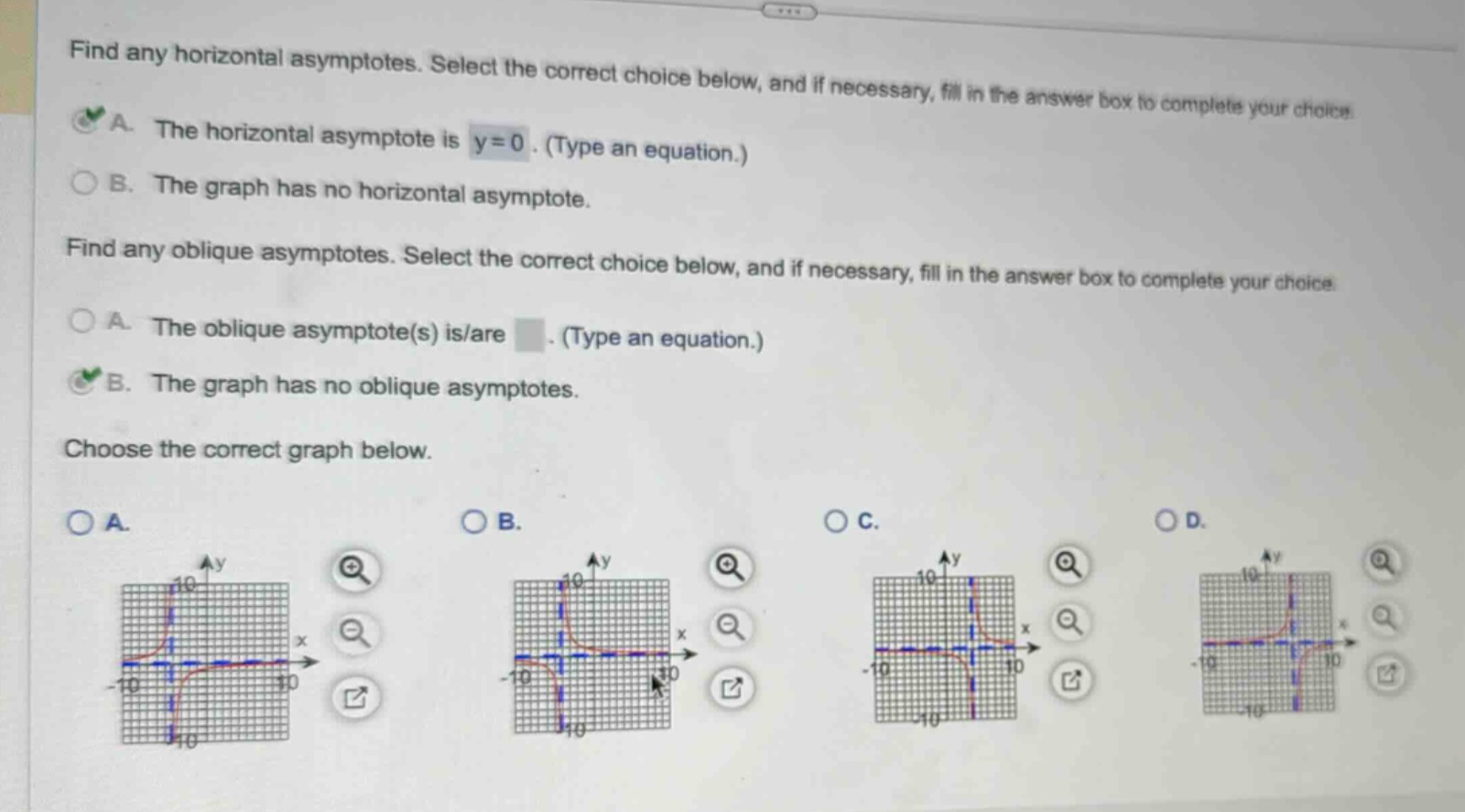
find any horizontal asymptotes. select the correct choice below, and if necessary, fill in the answer box to complete your choice. a. the horizontal asymptote is y = 0. (type an equation.) b. the graph has no horizontal asymptote. find any oblique asymptotes. select the correct choice below, and if necessary, fill in the answer box to complete your choice. a. the oblique asymptote(s) is/are. (type an equation.) b. the graph has no oblique asymptotes. choose the correct graph below. a. b. c. d.
Answer
Explanation:
Step1: Analyze horizontal asymptote
For a rational - function (y = \frac{f(x)}{g(x)}), if the degree of (f(x)) is less than the degree of (g(x)), the horizontal asymptote is (y = 0). Here, since the horizontal asymptote is (y = 0), it implies the degree - relationship as above.
Step2: Analyze oblique asymptote
An oblique asymptote occurs when the degree of the numerator of a rational function is exactly one more than the degree of the denominator. Since there are no oblique asymptotes, the degree of the numerator is not one more than the degree of the denominator.
Step3: Match graph
The graph with a horizontal asymptote at (y = 0) and no oblique asymptotes should have the curve approaching (y = 0) as (x\to\pm\infty). Without seeing the full details of the graphs, but based on the asymptote information: A graph with a horizontal asymptote (y = 0) and no oblique asymptotes will have the function values getting closer and closer to (y = 0) as (x) moves towards positive or negative infinity.
Answer:
We are given that the horizontal asymptote is (y = 0) and there are no oblique asymptotes. We need to choose the graph that has a horizontal line (y = 0) as an asymptote and no slant - like behavior as (x\to\pm\infty). Without the ability to describe the individual graphs in detail, if we assume the standard behavior of functions with these asymptotes, we look for a graph where the curve approaches the (x) - axis ((y = 0)) as (x) goes to positive and negative infinity and has no non - horizontal linear trend as (x\to\pm\infty). Since we don't have the full description of graphs A, B, C, D, we can't give a definite graph choice from the information provided. But if we were to choose based on the asymptote information only, we would look for a graph where the function values approach (y = 0) for large (|x|) values and has no slant asymptote behavior. If we assume the graphs are standard rational - function graphs, we would choose the graph that flattens out towards (y = 0) as (x\to\pm\infty) and has no non - horizontal linear approach as (x\to\pm\infty).
If we had to make a blind guess among the options without seeing the graphs in full detail, we note that a graph with horizontal asymptote (y = 0) and no oblique asymptotes should have the function approaching the (x) - axis for large (x) values. But without seeing the actual graphs A, B, C, D, we cannot accurately select the correct graph.
The horizontal asymptote answer is A. The horizontal asymptote is (y = 0). The oblique asymptote answer is B. The graph has no oblique asymptotes. The graph choice cannot be determined from the given information.