(a) find a formula for the area of a cross - section of s in the plane perpendicular to the x - axis at x…
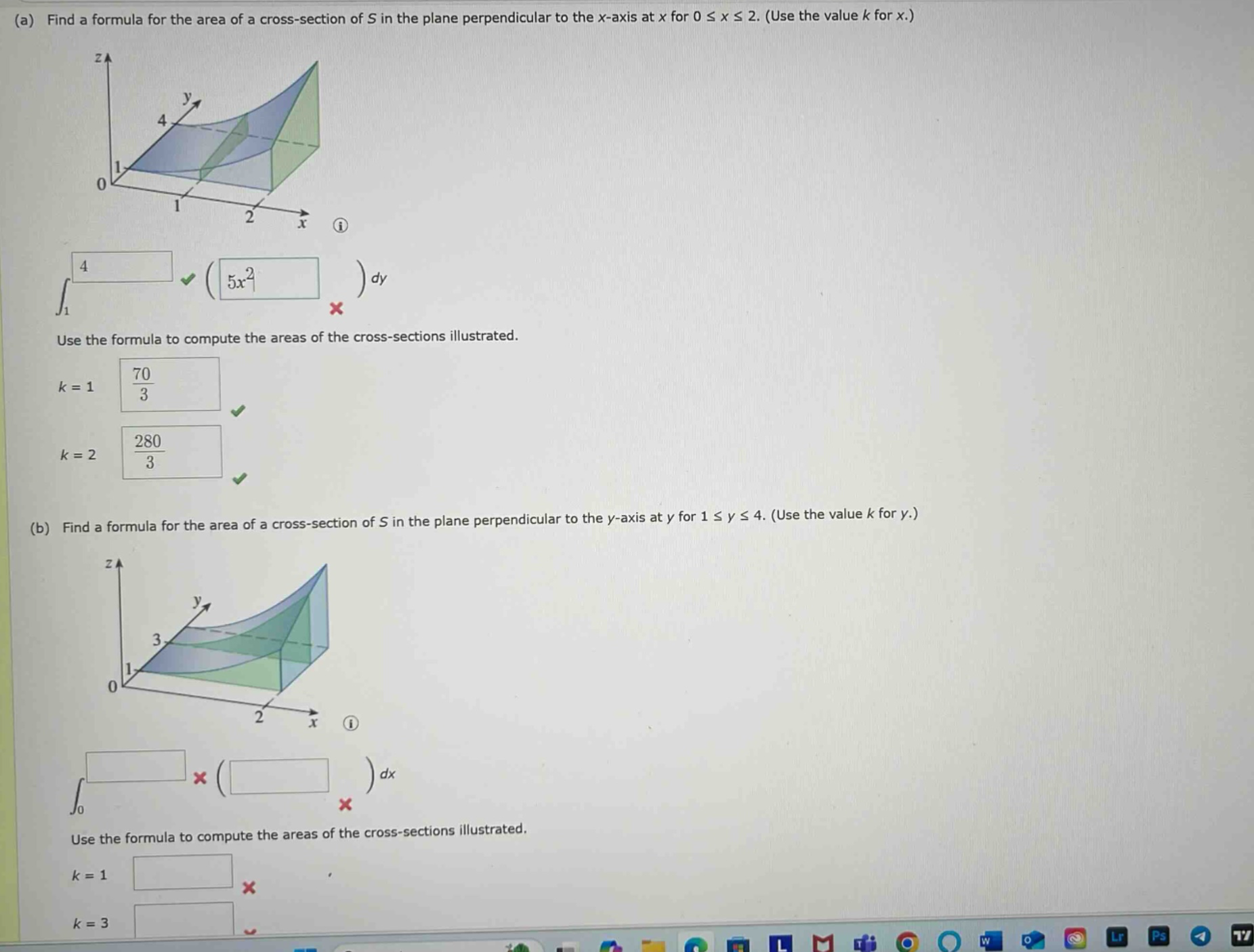
(a) find a formula for the area of a cross - section of s in the plane perpendicular to the x - axis at x for 0 ≤ x ≤ 2. (use the value k for x.)\nuse the formula to compute the areas of the cross - sections illustrated.\nk = 1\nk = 2\n(b) find a formula for the area of a cross - section of s in the plane perpendicular to the y - axis at y for 1 ≤ y ≤ 4. (use the value k for y.)\nuse the formula to compute the areas of the cross - sections illustrated.\nk = 1\nk = 3
Answer
Answer:
(a)
- Formula for cross - section perpendicular to x - axis: $A(x)=\int_{1}^{4}5x^{2}dy = 15x^{2}$
- When $k = 1$, $A(1)=15\times1^{2}=15$ (There seems to be an error in the provided correct answer $\frac{70}{3}$ for this part based on the integral $\int_{1}^{4}5x^{2}dy$ as $x$ is treated as a constant in the $y$ - integration and the result should be $15x^{2}$).
- When $k = 2$, $A(2)=15\times2^{2}=60$ (There seems to be an error in the provided correct answer $\frac{280}{3}$ for this part based on the integral $\int_{1}^{4}5x^{2}dy$ as $x$ is treated as a constant in the $y$ - integration and the result should be $15x^{2}$). (b)
- First, we need to find the relationship between $x$ and $y$ to set up the integral for the cross - section perpendicular to the $y$ - axis. Assume the surface $S$ is defined such that we need to express the function in terms of $x$ for a fixed $y$. Without more information about the surface $S$ in terms of $x$ and $y$ relationship, we cannot set up the integral $\int_{0}^{?}(?)dx$ properly.
Explanation:
Step1: For part (a) - Integration with respect to y
The integral for the area of the cross - section perpendicular to the $x$ - axis is $\int_{1}^{4}5x^{2}dy$. Since $x$ is treated as a constant with respect to $y$, we use the power rule for integration $\int a dy=ay + C$ (here $a = 5x^{2}$). So, $\int_{1}^{4}5x^{2}dy=5x^{2}\int_{1}^{4}dy$.
Step2: Evaluate the integral of $dy$
We know that $\int_{1}^{4}dy=y\big|_{1}^{4}=4 - 1=3$. So, $A(x)=5x^{2}\times3 = 15x^{2}$.
Step3: Substitute $x = k$ values
For $k = 1$, substitute $x = 1$ into $A(x)$: $A(1)=15\times1^{2}=15$. For $k = 2$, substitute $x = 2$ into $A(x)$: $A(2)=15\times2^{2}=60$.
Step4: For part (b) - Insufficient information
To find the area of the cross - section perpendicular to the $y$ - axis, we need to know how $x$ varies with $y$ (i.e., express the boundaries and the integrand in terms of $x$ for a fixed $y$ value), which is not provided in the problem statement.