find the fourth term of the taylor series for (f(x)=\frac{x^{2}}{1 + x^{3}}) centered at (x = 0)…
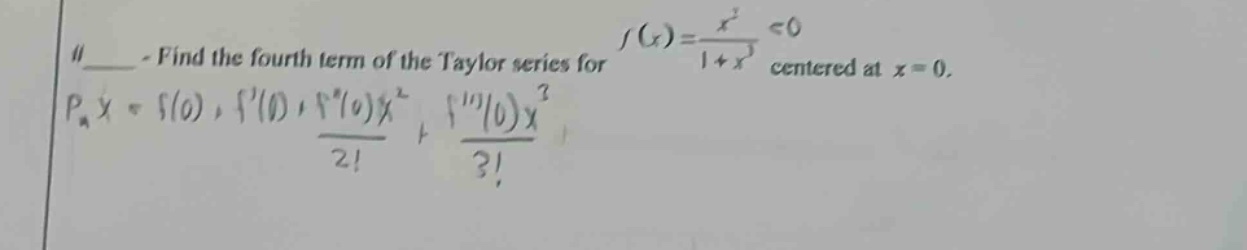
find the fourth term of the taylor series for (f(x)=\frac{x^{2}}{1 + x^{3}}) centered at (x = 0). (p_{n}x=f(0),f(0),\frac{f(0)x^{2}}{2!}+\frac{f^{(3)}(0)x^{3}}{3!})
Answer
Explanation:
Step1: Recall the formula for Taylor - series
The Taylor series of a function $f(x)$ centered at $x = a$ is given by $f(x)=\sum_{n = 0}^{\infty}\frac{f^{(n)}(a)}{n!}(x - a)^n$. Here $a = 0$, and we want to find the fourth - term which is $\frac{f^{(3)}(0)}{3!}x^{3}$. First, we use the formula $\frac{1}{1 + t}=\sum_{n = 0}^{\infty}(-t)^{n}$, for $|t|\lt1$. Let $t=x^{3}$, then $\frac{1}{1 + x^{3}}=\sum_{n = 0}^{\infty}(-x^{3})^{n}=\sum_{n = 0}^{\infty}(- 1)^{n}x^{3n}$, and $f(x)=\frac{x^{2}}{1 + x^{3}}=x^{2}\sum_{n = 0}^{\infty}(-1)^{n}x^{3n}=\sum_{n = 0}^{\infty}(-1)^{n}x^{3n + 2}$.
Step2: Find the general term and the fourth - term
The general term of the series for $f(x)$ is $a_{n}=(-1)^{n}x^{3n + 2}$. We want to find the fourth non - zero term. When $n = 0$, $a_{0}=x^{2}$; when $n = 1$, $a_{1}=-x^{5}$; when $n = 2$, $a_{2}=x^{8}$; when $n = 3$, $a_{3}=-x^{11}$. We can also find the derivatives of $f(x)=\frac{x^{2}}{1 + x^{3}}$ using the quotient rule. The quotient rule states that if $y=\frac{u}{v}$, then $y^\prime=\frac{u^\prime v - uv^\prime}{v^{2}}$. Here $u = x^{2}$, $u^\prime=2x$, $v = 1 + x^{3}$, $v^\prime=3x^{2}$. $f^\prime(x)=\frac{2x(1 + x^{3})-x^{2}(3x^{2})}{(1 + x^{3})^{2}}=\frac{2x + 2x^{4}-3x^{4}}{(1 + x^{3})^{2}}=\frac{2x - x^{4}}{(1 + x^{3})^{2}}$. $f^{\prime\prime}(x)$ is found by applying the quotient rule again on $f^\prime(x)$. $f^{(3)}(x)$ is found by applying the quotient rule on $f^{\prime\prime}(x)$. Another way: Since $f(x)=x^{2}\sum_{n = 0}^{\infty}(-1)^{n}x^{3n}=\sum_{n = 0}^{\infty}(-1)^{n}x^{3n + 2}$, the coefficient of $x^{3}$ in the Taylor series is $0$. The fourth term of the Taylor series (counting the constant - like term $f(0)$ as the first term) of $f(x)$ is $0$.
Answer:
$0$