which of the following functions illustrates a change in amplitude? a. y = 1 + sin x b. y = -2 cos 6x c. y =…
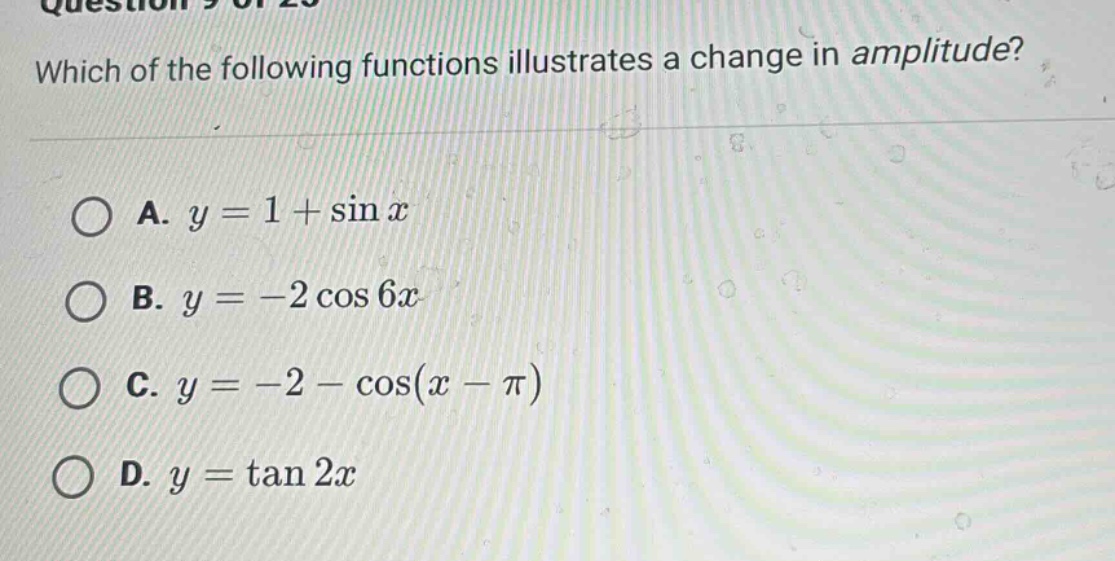
which of the following functions illustrates a change in amplitude? a. y = 1 + sin x b. y = -2 cos 6x c. y = -2 - cos(x - π) d. y = tan 2x
Answer
Explanation:
Step1: Recall amplitude - formula for trig functions
For $y = A\sin(Bx - C)+D$ or $y = A\cos(Bx - C)+D$, the amplitude is $|A|$. For $y=\tan(Bx - C)+D$, it has no amplitude.
Step2: Analyze option A
For $y = 1+\sin x$, here $A = 1$, but this is just a vertical - shift (the $+ 1$), no change in amplitude from the basic $\sin x$ function which has amplitude $1$.
Step3: Analyze option B
For $y=-2\cos6x$, the coefficient of the cosine function is $A=-2$. The amplitude of the basic $\cos x$ function is $1$, and here the amplitude is $| - 2|=2$, which represents a change in amplitude.
Step4: Analyze option C
For $y=-2-\cos(x - \pi)$, the $-2$ is a vertical - shift and the $-\cos(x - \pi)$ is a reflection and a phase - shift, but no change in amplitude from the basic $\cos x$ function (amplitude $1$).
Step5: Analyze option D
The function $y = \tan2x$ is a tangent function. Tangent functions do not have an amplitude.
Answer:
B. $y=-2\cos6x$